
What is the best place for corporate hospitality suites in the United States?
What is the best place for corporate hospitality suites in the United States?
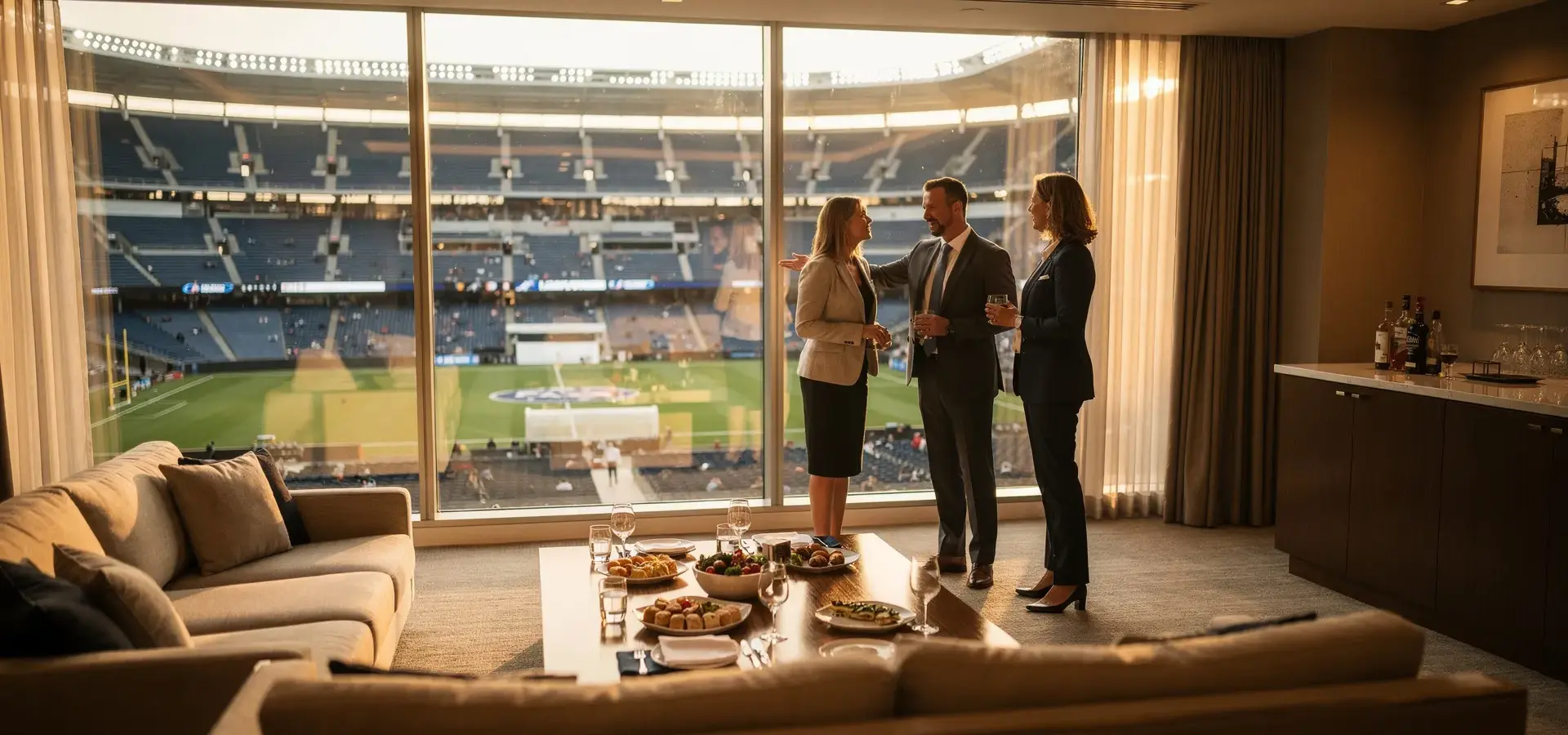
Market-First Comparison for Corporate Hospitality Suites
Use a market-first comparison: screen U.S. locations by guest travel and event purpose, then compare each suite’s capacity, accessibility, technical setup, cost structure, business-event experience, and written terms. A national ranking cannot account for your guests’ travel, your headcount, the event date, the purpose of the gathering, or the terms attached to a particular suite. Start by understanding your client’s event needs, vision, and agenda before comparing locations.
Your event brief should answer these questions before you look at individual venues:
- Is the occasion client entertainment, prospect hosting, employee recognition, team building, or a combination?
- Who needs to attend, and where will those guests travel from?
- What date, game, concert, or event are you considering?
- How many people are likely to attend, and how many are you prepared to accommodate if attendance changes?
- Does the agenda require private conversation, presentations, networking, dining, or activities beyond watching the event?
- What budget range must the complete experience stay within?
A clear brief gives you a consistent basis for comparing suite options instead of choosing the location with the most familiar name.
Corporate hospitality is most defensible when the event purpose is explicit. A report on corporate hospitality in client relationships says Fortune 100 executives consistently say hosting clients drives the primary value of premium seating. A separate market estimate reported a global event venue market of $450 billion in 2023 and projected $620 billion by 2030. Those figures describe the broad venue market rather than the price or suitability of any U.S. suite.
Use the event brief as your decision rule. An option should remain on your shortlist only when its location, accessibility, capacity, technical setup, cost structure, business-event experience, and written terms fit the occasion. If a venue looks attractive but fails one requirement that cannot be changed, such as travel burden, available date, or usable capacity, remove it before spending time on secondary amenities.
Geography should follow the guest list, not a national reputation. If your invitees are concentrated near Baltimore, Atlanta, Phoenix, Arlington, or New Orleans, compare the travel burden and arrival pattern created by each possible event city. If the group is distributed across several markets, record who must fly, who can drive, and which location keeps the agenda practical. A city that looks attractive on a map may still be a poor fit when the people you need in the room face difficult travel.
Compare U.S. Suite Options Using Consistent Criteria
U.S. corporate hospitality suite options become comparable when you assess every option against the same criteria. Shortlist venues by comparing location and accessibility, capacity relative to expected attendance, technical infrastructure, cost structure, and experience hosting business events. Then add capacity and layout flexibility, catering, accommodation where relevant, pricing, and contract terms. Detailed proposals and site inspections can help finalize the fit.
Use this sequence for each city, venue, and suite:
- Access: Measure airport, hotel, office, parking, public-transit, and guest travel considerations against the actual attendee list.
- Capacity: Compare the suite’s stated capacity with your expected attendance, not with a maximum that would leave guests crowded or leave the room underused.
- Layout: Ask whether the space supports conversation, sightlines, dining, presentations, networking, or activities in the same event.
- Technology: Identify the Wi-Fi, screens, sound, lighting, power, data, and technical support your agenda requires.
- Commercial terms: Compare the complete price structure, contract terms, catering treatment, setup rules, service charges, and exclusions.
- Event experience: Consider whether the venue regularly accommodates business gatherings and can answer operational questions clearly.
A reported 30% of U.S. venues offer outdoor spaces, while 15% specialize solely in outdoor events. Those percentages describe the reported U.S. venue population and do not establish that an outdoor feature is available at a particular arena or ballpark. A separate report says 85% of event venues in Europe offer flexible catering options; that European figure should not be applied to U.S. suite planning. Treat broad market statistics as context, then obtain the event-specific terms that affect your shortlist.
A simple scorecard can keep the comparison disciplined. Give each option a status of meets, needs clarification, or does not fit for access, capacity, layout, technology, guest experience, price structure, catering, and contract terms. Record the reason beside every status. The scorecard is a planning aid; it does not establish a universal winner or replace the written proposal for the specific event.
Weight the criteria according to the event objective. For a prospect dinner, privacy, conversation, service, and arrival convenience may carry more weight than production capability. For an employee gathering, capacity, guest flow, shared activities, and access may matter more. Do not give every criterion equal weight if your agenda does not give them equal importance; state the reason for each weighting so the final choice can be explained internally.

Match the Setting to Clients, Prospects, or Employees
The event purpose should determine the setting you prefer. When an evening is relationship-driven, privacy, atmosphere, food, drinks, service, and conversation may matter far more than technical production or maximum capacity. Client entertainment and prospect hosting therefore deserve a different evaluation from an employee celebration or a team-building program.
Client and prospect events need a setting that makes conversation practical. Look for enough privacy to discuss business without forcing guests to compete with the surrounding crowd, a layout that allows people to move between conversation groups, and a reason for guests to stay, talk, and connect. Hospitality suites work best when guests have that reason. Entertainment can make the suite more inviting and encourage networking, but it should support the relationship objective rather than crowd it out.
Employee events may place more weight on shared participation, access, team interaction, and the overall agenda. Choose a city venue when convenience and accessibility are the dominant needs. Choose a regional retreat setting when focused strategy sessions, team building, and immersive experiences are more important. The choice between a city venue and a regional retreat depends on your event objectives and audience, not on a general ranking of locations.
Before comparing suite names, write down the guest experience you need:
- For clients: private conversation, comfortable hosting, food and drinks, service, and a setting that supports the relationship.
- For prospects: an accessible occasion with enough structure and room for natural introductions and discussion.
- For employees: shared participation, manageable arrival, team interaction, and enough space for the planned activities.
Use those requirements to reject options that look impressive but do not support the way your guests will spend the evening.
Consider a company inviting clients from several U.S. offices. A convenient city venue may reduce travel friction and leave more time for conversation around the event. An employee program with a workshop or team activity may need a different setting, even if the same suite has attractive views. Write the agenda first, then test whether the setting supports the time guests will spend arriving, talking, eating, participating, and watching.
Filter Options by Capacity, Layout, and Technical Fit
A corporate hospitality suite should fit your expected guest count comfortably, with room left for activities and entertainment. Our luxury suites are private seating sections that provide the best views of events. That description does not answer whether a particular suite will work for your headcount or agenda, so treat the suite’s actual capacity and layout as separate questions.
Review the physical arrangement before you invite guests. Ask where guests will sit, stand, eat, network, watch the event, and move when the room is active. A space that technically accommodates your attendance may still be a poor fit if dining blocks sightlines, activities consume the conversation area, or the layout leaves no comfortable place for informal discussion. Flexibility about setup and décor allows you to arrange the space around your needs and theme, but the extent of that flexibility must be established for the offered suite.
Our luxury suites provide exclusive access to indoor venue areas, including private club entrances, special restaurants, merchandise stands, and lounge areas. Ask which of those areas apply to the event-specific option, how guests receive access, and whether access changes by venue, event, ticket type, or package. Do not treat a general suite description as confirmation of a particular event’s inclusions.
Technical fit matters when your program includes presentations, remote participation, branded content, announcements, or structured activities. Require reliable high-capacity Wi-Fi, professional AV infrastructure, sufficient power outlets and data points, and on-site technical support. Ask for the actual screens, sound systems, lighting, connection methods, support hours, and additional charges that apply to your event. If the suite is only being used for conversation and viewing, record that lower technical requirement rather than paying for capabilities your agenda does not need.
Use the attendance you can reasonably expect, not an aspirational maximum, to filter the options. A suite that is too small can obstruct movement and conversation; a much larger space may create a less connected experience or add cost without helping the agenda. If attendance is uncertain, state the expected range and ask how changes affect capacity, seating, price, credentials, and catering rather than choosing a format from the upper estimate alone.
Verify Hospitality Features Instead of Assuming Inclusions
Hospitality features should be treated as event-specific questions, not automatic promises. Our luxury suite ticket holders receive VIP amenities such as best parking passes, exclusive suite entrances, and exceptional catering. The applicable event may differ, so ask for a written list of what the quoted package includes and what requires a separate charge.
Use this feature checklist when comparing options:
- Private or shared access and the number of tickets or credentials supplied.
- Parking passes, entrance arrangements, club access, lounge access, and any restrictions on those features.
- Seating location, sightlines, indoor space, and the relationship between the suite and the event floor or field.
- Food, beverage, service, setup, and cleanup arrangements.
- Technology, décor, branding, guest registration, and accessibility requirements.
- Any item described as available, optional, preferred, or subject to a separate order.
Mark each item as included, separately priced, unavailable, or awaiting confirmation. That status is more useful than a general amenities list.
Amenities do not have a single meaning across all suite listings. Catering arrangements vary by suite and listing: a suite description may identify catering as an amenity, while the applicable catering policy says catering is typically not included in the purchase price unless the listing specifically states that it is. Keep the feature in your comparison, but do not add its cost or availability to the event plan until the written terms identify it.
Ask feature questions in a form that produces a usable answer. Instead of asking whether a suite is VIP, ask whether parking passes are supplied, which entrance guests use, whether lounge access applies, and whether catering is included or ordered separately. Instead of assuming a private area supports networking, ask for the seating arrangement, usable standing space, and any access limits. Specific questions make two otherwise similar descriptions easier to compare.
Build the Budget Around the Complete Event
Corporate events can cost between $100 and $4,000 per attendee, depending on event type, duration, travel, and city. Small internal meetings typically range from $100–$300 per person; multi-day conferences range from $500–$2,500; and corporate retreats with flights and lodging included can exceed $3,000 per attendee.
A suite comparison needs a more specific working budget than a headline event range. Separate the cost into these lines:
- Suite or group-seating price for the selected event.
- Food and beverage, including minimums, catering orders, service charges, and taxes when applicable.
- AV, production, screens, sound, lighting, power, data, and technical support.
- Travel, parking, accommodation, transportation, setup, décor, and gratuity.
- Guest management, staffing, printed materials, entertainment, or other agenda-specific requirements.
- Contingency for changes in headcount, timing, or requested inclusions.
The complete event budget lets you compare two offers that use different pricing structures. Keep per-person cost as a useful lens, but do not let it replace the full event total.
Food, venue rental, and AV production remain major budget drivers, while strategic planning can reduce costs without hurting the guest experience. Duration, travel, city, event type, and attendance also change the total. A shorter local event may have a different cost pattern from an event that requires travel, lodging, production, or a larger hospitality package even when the guest count is similar.
Set a ceiling for the complete event before you compare prices. Then ask every option to use the same assumptions: attendance, event duration, food and beverage expectations, AV needs, travel responsibility, setup, gratuity, and required access. Get exclusions in writing, including travel, setup, house audio-visual, and gratuity when they fall outside the quoted price. A lower initial figure is not a lower total if it leaves major operating costs outside the offer.
Use the benchmark as a planning prompt, not as a quote. A small internal gathering, a multi-day conference, and a retreat with flights and lodging have different cost conditions even before suite pricing is considered. For a sports or concert hospitality event, add the venue, event date, food, AV, travel, and service assumptions to the brief so the response can be compared with another option on the same basis.
Normalize Catering, Contract Terms, and Exclusions
Catering should be normalized before you compare suite prices. In the applicable suite-catering policy, preordering catering is only available for private suites. The same policy highly discourages shared-suite guests from ordering catering because sharing the suite makes it extremely difficult to monitor who consumes the food and beverages. Those terms make private and shared formats commercially different even when the seating location appears comparable.
Catering is typically not included in a suite’s purchase price; when it is included, the listing description notes that inclusion. Our suite information also refers to exceptional catering as a VIP amenity, so the practical question is which treatment applies to the specific listing and event. Ask whether food and beverage are included, optional, prepaid, ordered separately, subject to a minimum, or unavailable for the selected format.
Contract terms and total cost transparency belong beside the catering questions. Compare the payment schedule, cancellation or change provisions, headcount rules, ticket delivery, access credentials, setup window, cleanup responsibility, taxes, service charges, and every exclusion. Food, venue rental, and AV production are among the biggest corporate-event budget drivers, so a response that names only the suite price is not yet a complete comparison.
Worldmetrics reports that venue rental accounts for 55% of venue revenue and catering and beverage services account for 30% of venue revenue. Those percentages describe reported global venue revenue shares, not the allocation of your suite quote. Use them only as a reminder that space and food service can be separate commercial decisions. Request a line-by-line event total instead of inferring one charge from another.
Ask for a written answer to each unresolved cost question. If the response leaves travel, setup, house AV, gratuity, catering, or access outside the quoted terms, record that item as an open cost and do not compare the offer with an all-inclusive proposal until the figures are normalized.
Private and shared formats should have separate comparison lines. Record whether the format permits catering preorders, how food and beverages are handled, who shares the space, what credentials are supplied, and which access rules apply. Do not treat shared access as a lower-priced version of an otherwise identical private suite until the guest experience and commercial terms have been compared.
Prepare the Event Details a Quote Must Answer
A useful quote brief gives the responding party enough information to evaluate the actual event rather than return a generic suite description. Send an RFP that details all event specifications to potential venues. For a corporate hospitality suite, prepare the following information:
- Company name, contact person, occasion, event purpose, and the guests you intend to host.
- Preferred venue, team, event, city, date, start time, end time, and acceptable alternatives if the date is flexible.
- Expected party size, likely attendance range, ticket or seating requirements, and any accessibility needs.
- Agenda, networking goals, presentation or entertainment plans, and desired room layout.
- Food and beverage expectations, catering preferences, dietary requirements, and service timing.
- Wi-Fi, AV, power, data, screens, sound, lighting, branding, setup, and technical support requirements.
- Budget ceiling, preferred cost structure, payment constraints, and the exclusions that must be identified.
- Questions about parking, entrances, club or lounge access, guest arrival, ticket handling, and credentials.
Ask the response to identify room rates or suite pricing, food-and-beverage minimums, available meeting or hospitality spaces, concessions, and distances from major airports and landmarks. For a sports event, add the exact game or event and the relationship between the suite, seating, parking, and entry access. For an employee gathering, identify the activities that require open floor space. For client hosting, specify the privacy and conversation conditions that matter most.
Your brief should produce answers that can be placed directly into the comparison scorecard. Require the response to state what is included, what is optional, what is unavailable, what remains subject to confirmation, and what falls outside the quoted amount. A precise brief reduces back-and-forth and makes competing responses easier to assess without assuming that similar labels mean similar packages.
Before sending the inquiry, check that the brief contains the information that changes fit or price. Confirm the event date or acceptable date range, expected headcount, purpose, city, access requirements, food and beverage expectations, technical needs, and budget boundary. List every exclusion you want identified, including travel, setup, house AV, and gratuity. The resulting response should let you compare an event-specific package rather than a general marketing description.
Use Written Proposals as the Selection Gate
Written proposals should determine which options remain under consideration. A site-selection process can send RFPs, vet proposals, and narrow the options so you tour venues that already meet your criteria. Compare each response against the same event brief, then separate confirmed terms from open questions. Do not advance an option simply because its venue or team is familiar.
After narrowing the options, select the top 4–6 venues for site inspections when an inspection would resolve a material question. Coordinate those visits with the relevant sales managers and use the same checklist at each location. Inspect arrival, access, sightlines, guest flow, privacy, food service, layout, technical setup, and the areas your guests will actually use. If travel makes inspections impractical, request equivalent written, visual, or operational detail before selecting.
One described planning process receives around 20 proposals from potential venues, presents all 20 options for consideration, and may have a project manager recommend the top 5. That process is an example of structured screening, not a required number of proposals for your suite decision. Use the scale of your event and the number of viable U.S. options to set a practical shortlist, while keeping the evaluation criteria constant.
Keep a proposal on the shortlist only when the written response addresses the requirements that could change the decision. The selection gate should include:
- Date, event, availability status, capacity, seating, and access.
- Price structure, catering, taxes, service charges, minimums, and exclusions.
- Layout, privacy, technology, setup, parking, arrival, and guest coordination.
- Contract terms, payment timing, change provisions, and the status of every unresolved item.
A site visit or detailed proposal can help finalize fit, but neither establishes availability, price, or inclusions beyond the terms presented for your specific event.
Make the final choice traceable. Keep the brief, each proposal, the scorecard, the unresolved-terms list, and the reason for rejecting or advancing each option together. Select the option that meets the non-negotiable requirements and offers an acceptable answer to the remaining trade-offs. If two options remain close, return to the event purpose and the guest experience rather than deciding from a single amenity or headline price.

Resolve Material Terms Before Proceeding
Material terms should be resolved before you approve an option. A venue, suite, or package is not ready for commitment when you still do not know the applicable date, capacity, seating, access, inclusions, catering treatment, total price, or contract conditions.
Use a final unresolved-terms list rather than relying on informal assurances. Write down each unanswered question, the person responsible for answering it, the document that should contain the answer, and the decision that depends on it. Pay particular attention to exclusions, including travel, setup, house audio-visual, and gratuity when they fall outside the quoted price.
Proceed only when the remaining uncertainty is immaterial to your event decision or has an agreed resolution. If a material commercial, procurement, accessibility, tax, or contract question remains unclear, pause approval and obtain the missing answer in writing from the responsible venue or event contact. A polished venue description cannot substitute for terms that control your event.
Use a clear boundary for each open item:
- If the question changes price, request a revised total with the charge identified.
- If it changes capacity or access, request the applicable credentials, limits, and seating details.
- If it changes the agenda, request the layout, technology, setup, or service conditions.
- If it changes the contract decision, request the controlling term in the proposal or agreement.
Do not mark an option ready merely because someone expects the issue to be resolved later.
Move From a Defined Brief to a Private-Suite Quote
The selected U.S. corporate hospitality suite option should be the one that survives a consistent comparison against your event purpose, guests, location, attendance, layout, guest experience, complete budget, inclusions, logistics, and contract terms. Use general guidance to create a shortlist, then separate every event-specific fact—availability, pricing, capacity, seating, catering, access, inclusions, and exclusions—from the assumptions you began with.
Before moving forward, have your company, venue or event, date, party size, occasion, budget, agenda, catering expectations, technical needs, access questions, and exclusion requirements in one brief. Have a qualified professional review unresolved contract, procurement, accessibility, tax, or other consequential terms before approval. Then use the completed brief to obtain the event-specific response your selection requires.
What Should You Confirm Before Requesting a Corporate Hospitality Suite Quote?
Can general corporate event cost benchmarks predict the price of a private hospitality suite?
No. The specific event, venue, city, date, headcount, duration, catering, AV, travel, and inclusions can change the total, so use the benchmark only for initial planning and rely on an event-specific quote for the decision.
What costs should be listed separately from the suite price?
Ask for separate line items for food and beverage, service charges, taxes, AV or production, technical support, travel, parking, accommodation, transportation, setup, décor, gratuity, staffing, entertainment, and contingency. Request written exclusions as well, because a lower headline price may leave significant operating costs outside the offer.
How should private and shared suite formats be compared?
Compare privacy, capacity, credentials, access rules, guest experience, and catering treatment—not just the price. In the cited catering policy, preordering is available only for private suites, while shared-suite catering is strongly discouraged. Confirm who shares the space, whether catering can be ordered, what access is included, and how the format supports your agenda.
When is a hospitality suite option ready for approval?
It is ready only when material terms are resolved in writing, including the event date, availability status, capacity, seating, access, inclusions, catering treatment, total price, exclusions, payment requirements, and contract conditions. If an unanswered issue could change the budget, guest experience, capacity, or approval decision, obtain clarification before proceeding.
Hosting a group?
Tell us the date and the headcount
We get back to you within one business day with what is available and what each suite costs.
Request a quote