
hospitality suites
What Are Hospitality Suites? A Corporate Event Planner’s Guide to Fit and Quote Requests
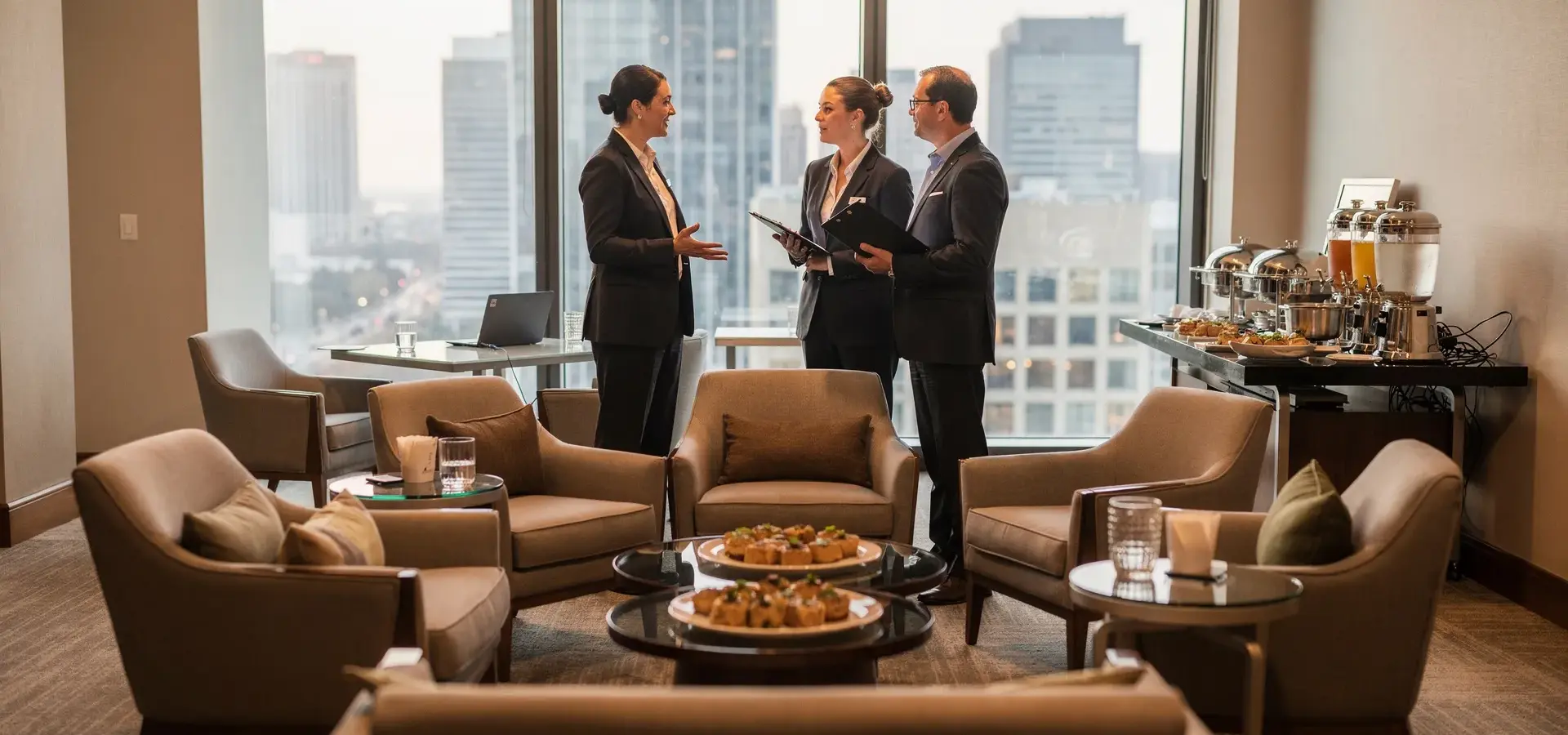
Define hospitality suites as a corporate event format
A hospitality suite is a luxury box or enclosed venue room inside a stadium, arena, or other sporting or entertainment venue, giving your group a private place to watch an event together. For a corporate event, the format fits when the shared live experience and private setting support a clear hosting purpose. Use LuxuryVIPSuites.com as the next planning route when you are ready to turn that purpose into an event-specific inquiry.
The physical arrangement can vary by venue. In one agreement for the Mitchell Center at the University of South Alabama in Mobile, Alabama, the hospitality suite is an enclosed room at concourse level, with viewing access from the suite and eleven seats in front of it. That example shows why you should ask what the room includes, where guests watch from, and how the seating connects to the enclosed space rather than assuming every venue uses the same layout.
A separate corporate-event example shows how much a venue package can add around the room itself. Pelazzio lists its Paradise package at $109 per guest for a 100-guest minimum and 6 hours, with the price excluding tax and service charges; the listed package includes buffet dinner and hors d’oeuvres, a 4-hour premium bar with unlimited soft drinks, a DJ and emcee, up to 8 hours of photography, a custom cake, upgraded linens, floral centerpieces, uplighting, and full event staffing. Treat that as a named package example, not as a standard suite price or inclusion list.
Match a hospitality suite to a corporate hosting purpose
Use the hospitality-suite format to support a defined corporate purpose: client appreciation, a trade show reception, a leadership dinner, or sales-prospect hosting in a stadium suite. Decide what you want guests to do together before choosing the event or room.
For client entertainment, plan for conversation rather than treating the event as a passive ticket handoff. Client entertainment typically aims to help you learn more about a client and the client’s business in an interesting environment that favors openness and peer-to-peer discussion, while hospitality entertainment can give clients a reason to stay longer. Hosting clients is reported as the primary value of premium seating by Fortune 100 executives.
Employee occasions in corporate planning include team building, motivational events, receptions, parties, and incentive travel. Entertainment venues can create relaxed atmospheres where employees connect through shared experiences. Your guest list, agenda, and hosting style should match whether the event is recognition, team connection, or relationship development.
Before asking for a quote, write down three decisions:
- Who needs to attend, and why does each group belong at the event?
- What should happen during the shared experience: conversation, recognition, introductions, or team connection?
- How will you judge whether the event served that purpose without promising a particular business result?
A defined purpose gives you a better basis for choosing the guest group, event type, and operating details.

Compare private suites with conventional corporate settings
A private suite and a conventional corporate setting solve different planning problems. Use the comparison below to identify which environment supports your guest interaction, privacy needs, and operating model.
| Planning criterion | Private suite | Conventional corporate setting |
|---|---|---|
| Shared experience | Guests can watch the live event together from a private venue space. | Guests may need a scheduled agenda, presentation, or activity to create the shared focus. |
| Conversation | Build time for informal discussion around the event and between key guests. | Use the room layout and agenda to create the conversation pattern you need. |
| Privacy | An enclosed suite can give you a controlled setting within the larger venue. | Compare the privacy of the selected hotel, meeting room, or on-site event space with the sensitivity of the occasion. |
| Food and service | Ask what catering, beverages, entrances, parking, and guest access are included. | Determine whether food, beverage, entertainment, and coordination sit under one package or require separate vendors. |
| Administration | Confirm the event-specific room, access, and hospitality terms before approval. | Integrated packages can reduce the administrative burden of managing multiple vendors, while a room booking may still require separate presentation, refreshment, and registration arrangements. |
Published corporate packages also show why you should compare the whole occasion rather than a headline room price. Pelazzio lists its Paradise package at $109 per guest for 100 guests and 6 hours, excluding tax and service charges, and says every corporate booking includes a dedicated event coordinator plus a full planning meeting 6–8 weeks before the event. Those terms describe Pelazzio’s package; they do not establish what a private suite at another venue includes.
Choose the private-suite route when the live event is part of the reason guests should gather and the enclosed setting helps you host the group. Choose a conventional setting when your objective depends more on a controlled presentation, a formal agenda, or a room arrangement that the event itself does not provide. In either case, compare the operating work as carefully as the guest-facing experience.
Check guest count, venue access, catering, and planning fit
Start with the group you expect to use the space, not the largest possible invitation list. If you are considering a hotel-based hospitality room as an alternative, a standard double room is rarely large enough for a group, while junior suites, one-bedroom suites, or interconnecting rooms work far better for groups of more than six to eight guests. Use that comparison to ask about usable space, circulation, and where guests will sit or stand.
Access and service can decide whether the format works in practice. Choose a suite that guests can easily reach from the main event, and ask how the entrance, event location, parking, and guest movement fit together. Some properties have specific food-and-beverage policies for guest rooms, particularly when outside catering is involved, so put dietary needs, service timing, outside vendors, and beverage expectations into the planning brief.
Do not judge planning effort by headcount alone. Planning hospitality for 50 senior managers can be as complicated as planning a conference for 500 attendees because guest coordination, approvals, vendors, access, and timing still need owners. For smaller corporate events, the requirements may include a room booking, presentation facilities, break-out refreshments, and registration.
Use this checklist before you request a quote:
- Guest plan: expected attendance, invitees, decision-makers, accessibility needs, and a realistic arrival pattern.
- Event fit: the game, concert, or other event; the business purpose; and the amount of time guests should spend together.
- Operating needs: parking, entrances, guest registration, presentations, staffing, and who will manage the event on site.
- Food and beverage: preferred format, dietary requirements, service timing, and whether outside catering is relevant.
- Approval test: the cost categories, internal approvers, and success measures your organization will use to judge the occasion.
If your company is evaluating a longer-term suite commitment, track true costs, define meaningful measures, manage the guest list, and report results. For a single event, use the same logic to keep the brief specific and reviewable.

Prepare the event details for a private-suite quote
A useful inquiry gives the quoting team enough context to assess the event rather than only the number of tickets. Prepare these details:
- event date, venue, city, and the specific game, concert, or event;
- expected party size, guest categories, and the occasion;
- desired viewing arrangement, seating needs, accessibility requirements, and privacy expectations;
- catering, beverage, dietary, parking, entrance, and guest-management requirements; and
- internal approval limits, timing, and any contract or documentation requirements you already know about.
Our luxury suite ticket holders receive VIP amenities such as best parking passes, exclusive suite entrances, and exceptional catering. Ask for each requested amenity in the event-specific response instead of assuming it applies to every venue or date.
Viewing arrangements and terms deserve their own line in the brief. The Mitchell Center agreement permits the client to view the event from the hospitality suite and from the eleven seats in front of it, and its arrangement uses a license agreement naming a suite number and defining when the term starts and ends. A hospitality-suite agreement can grant use of a designated suite for a stated term, but the specific layout and access should be addressed for your event.
Build timing into the inquiry. For a top Manhattan venue on a Saturday date in September through November, begin the venue search and event brief 12 months before the event. For off-peak events and mid-size corporate bookings, 4–6 months is described as the standard timeline, although September and October options may already be limited then. As another package example, Pelazzio lists its Exclusive Rental corporate package at $45 per guest, with a 75-guest minimum and 6 hours; it includes the ballroom, foyer, and dressing suite with tables, dinnerware, basic linens, centerpieces, non-alcoholic beverages, and full event staffing, and permits clients to bring their own caterer and vendors.
Keep the brief easy to answer. Put the fixed details first, then separate preferences from requirements: the date and venue are different questions from the desired view, the catering format, or a preferred amenity. This structure helps you compare a response against the event purpose and approval path without treating a package example as a universal offer.
Start With the Physical Suite Format
Start with the physical arrangement: a hospitality suite can be an enclosed venue room with viewing access or a private seating section within a stadium, arena, or other entertainment venue. You do not need every preference settled, but you do need enough information for the open questions to be identified and answered.
Proceed with the suite brief when:
- the private setting supports the business purpose;
- the live event gives guests a shared reason to gather;
- the expected party size and guest roles are clear; and
- your organization knows who will review the response and approve the event.
Put the defined details into the inquiry and ask for the remaining event-specific terms.
Revise the brief before proceeding when:
- the guest list is still a broad estimate with no hosting purpose;
- the event does not give the group a useful shared experience;
- the venue, date, access, catering, or viewing requirements are still unclear; or
- internal approval depends on information you have not requested.
Narrow the occasion, clarify the guest plan, and then return to the quote brief.
Venue administration can also affect readiness. At most New York venues, submit the certificate of insurance 30 days before the event; missing that deadline can void the booking at certain properties. Add documentation deadlines to your internal schedule as soon as the venue and event are known.
Confirm unresolved terms before approval
Keep approval pending while a material term could change whether the event works. Review the proposed suite location, viewing arrangement, guest access, catering and beverage plan, parking, contract requirements, documentation, cancellation language, and the responsibilities assigned to your team. Convert each open point into a written question rather than relying on a general package description.
Use the planning timeline to decide how much coordination you need. Schedule the RFP process, site visits, proposal evaluation, and contract-term negotiation at 10–11 months before the event when that timeline applies. At 9–10 months before the event, run the contract, submit the first deposit, secure the venue, and begin vendor booking on the confirmed date and location.
A shorter runway changes the planning approach. At 90 days before the event, New York venue planning is described as constrained but actionable with specialist support, and cancellation inventory or less in-demand venues may provide viable options. If your event is this close, send a complete brief, identify the decisions that cannot move, and ask for help sourcing options that fit those constraints.
Approve the event only after the response answers the questions that matter to your guest experience and operating plan. If a material answer remains open, keep the approval path active but do not treat the proposal as a settled event plan.

Request an event-specific private-suite quote
A hospitality suite is a practical fit when your guest group has a clear reason to gather, the live event supports that purpose, and your team can manage the access, service, and approval details. Before you move ahead, have the venue, event date, party size, occasion, viewing needs, catering preferences, requested amenities, and internal requirements ready. Price, inventory, and inclusions are confirmed for the specific event.
What should a corporate planner confirm before approving a hospitality suite?
Is a hospitality suite a room, a seating area, or both?
It can be both. A suite may be an enclosed room inside a stadium, arena, or entertainment venue with event-viewing access, while the seating arrangement can vary. In one Mitchell Center agreement, guests could view the event from the suite and from eleven seats in front of it, so confirm the room layout and included seats for the specific event.
Can a hotel suite replace a venue hospitality suite for a corporate event?
Sometimes, but the two settings solve different problems. A hotel suite may provide privacy, while a venue suite keeps guests close to the live event; either option requires checking usable space, guest access, proximity, and food-and-beverage rules. A standard double hotel room is rarely large enough for groups of more than six to eight guests, so consider a larger suite or interconnecting rooms when appropriate.
What should a company confirm before approving a hospitality suite?
Confirm the specific suite location, viewing arrangement, guest access, parking, catering and beverage plan, contract requirements, documentation deadlines, cancellation terms, and responsibilities for your team. Keep approval pending if any unresolved term could change the guest experience or operating plan, and evaluate the event against the hosting purpose you defined.
Hosting a group?
Tell us the date and the headcount
We get back to you within one business day with what is available and what each suite costs.
Request a quote