
arrowhead stadium suites
Arrowhead Stadium Suites: A Corporate Decision Guide for Guest Fit, Cost, and Quote Requests
Start with Arrowhead’s capacity and access constraints
Start with an Arrowhead-specific screen: compare the published 10-20-person suite capacity with your invited group, then verify the package’s access, privacy, and entry terms. If the group mainly needs field views and club amenities, or exceeds that capacity, compare club seats or another format before building an approval case.
The decision should follow the interaction you need to create. Start with the guest count, identify how much conversation the event requires, then separate the features you need from the features you would simply enjoy. LuxuryVIPSuites.com has been in business since 1992, and we can help you frame an Arrowhead request around the event details a quote must answer.
Your hosting plan should answer four questions before you compare prices:
- Will clients need to move between conversation, food, and the game without leaving the group’s shared space?
- Do you need a private room where you can welcome guests, introduce colleagues, and hold a quiet business conversation?
- Does the event justify paying for coordination and hospitality rather than buying the least expensive available seat?
- Can your company approve the complete cost after reviewing attendance, inclusions, access, and internal gifting or entertainment rules?
A private suite is a practical candidate when the answer to the first two questions is yes. If your guests are attending mainly for the action and you do not need a private hosting environment, compare club seats before you commit to a suite format.
Test the group against a private Arrowhead format
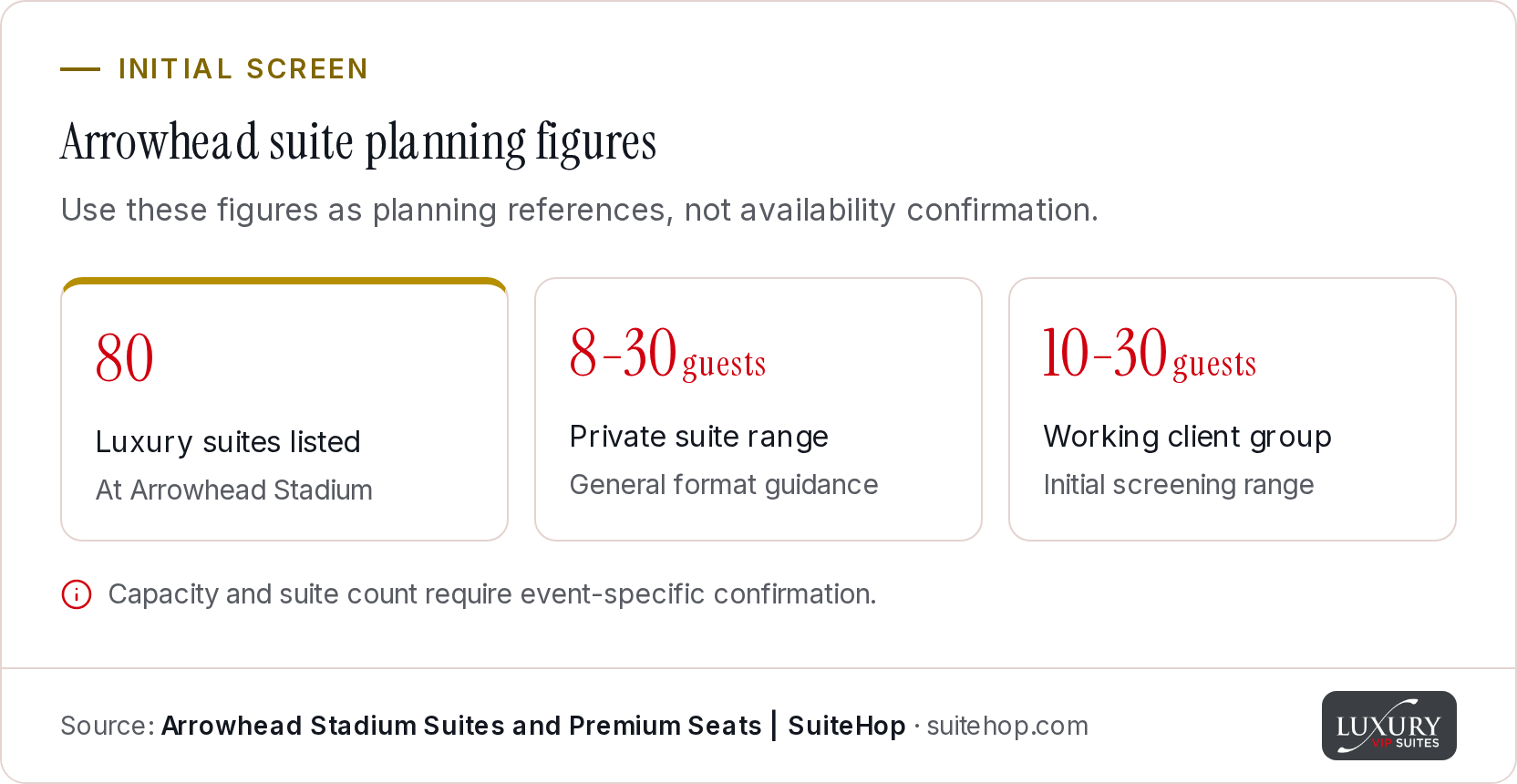
Group size is the first screening test for an Arrowhead Stadium suite. SuiteHop lists 80 luxury suites at Arrowhead Stadium, while a separate suite listing describes private suites as an intimate space for 8-30 guests; use those figures as planning references, not as confirmation that a particular suite is available or suitable for your event.
A 10-30-person client group falls within that general screening range, but capacity alone does not settle the choice. Your guests need enough usable space to enter, sit, speak with you, and move through the event without turning the host area into a queue. Ask for the specific suite’s stated capacity, seating layout, number of tickets, sightline, and location before you invite clients.
Use this group-fit checklist for the initial screen:
- Guest count: Set a working number that includes clients, prospects, partners, executives, and your internal hosts.
- Attendance pattern: Mark expected guests separately from people who may attend. A suite that fits your maximum group may feel poorly used if several invitees decline.
- Conversation need: Decide whether guests will spend meaningful time talking or whether the event is primarily a shared viewing experience.
- Host movement: Allow room for introductions, food service, and conversations that do not happen from a fixed seat.
- Relationship mix: Note whether senior clients, prospects, or several companies will share the space. That mix can change the privacy and seating requirements.
A private suite is worth pursuing when the group needs one shared setting and the hosting plan depends on interaction. Request another format when the proposed group is too small to justify the space or too large for the confirmed capacity.
The 8-30-guest range describes what private suites can offer, and suites often cost less per person than individual premium seats; both points are general suite-format guidance rather than a promise about a specific Arrowhead suite. Catering is typically an additional cost unless the listing specifies otherwise, so include food and beverage as a separate line in your planning brief.
Do not make a client invitation from the broad capacity range. Make it only after the selected event, suite, ticket count, seating arrangement, and included access have been written into the quote or contract.

Compare Arrowhead formats by access, privacy, and timing
The right Arrowhead format depends on what your guests need to do during the event. A private suite gives you a dedicated setting for hosting; club seats give you premium seating and shared club amenities; ordinary seating may be enough when privacy and hosted food are not part of the objective.
| Format | Privacy and conversation | Viewing and seating | Food, beverage, and access | Use it when |
|---|---|---|---|---|
| Private suite | A private room and shared host area can support introductions and conversation; confirm the layout | Suites offer field sightlines; confirm the view and location for the event | Early entry, club-level concessions, catering, and other features require suite-specific confirmation | You need a coordinated client experience in one private setting |
| Club seats | Shared seating offers less control over conversation and guest movement | Arrowhead club seats are described as comfortable, with extra legroom and field sightlines | The CommunityAmerica Club Level includes dining, premium drinks, lounges, bars, and temperature-controlled concourses | You want premium seating and club amenities without a private room |
| Ordinary seating | Conversation depends on the section and the game environment | Choose it when viewing the event is the main purpose | Food, beverage, and access follow the ordinary venue arrangement | The event does not need private hosting space or organized hospitality |
For Chiefs games, the CommunityAmerica Club Level remains open through 1 hour after the game. The club level includes upscale dining, premium drinks, temperature-controlled concourses, lounges and bars, and premium parking based on availability. The Champions Club is above section 203 on that club level and includes all-inclusive food and beverage.
Those details make club seating a meaningful comparison rather than a fallback category. Ask whether your guests need the privacy of a suite or whether the club-level environment already supplies enough comfort, food access, and time around the game for the relationship you are hosting.
Run the experience test before you run the math:
- Write the first conversation you want to have with the group.
- Decide whether that conversation needs a closed room, a shared lounge-like area, or only nearby seats.
- Identify when guests will eat, arrive, meet your team, and leave.
- Mark the moments where a shared club environment would interrupt the hosting plan.
- Choose the least complex format that still supports those moments.
The result should be a format decision with a reason attached. “Suite” is not the reason; private conversation, coordinated arrival, hosted food, or a shared executive setting may be the reason.
Price belongs after the experience and capacity screen. Arrowhead Stadium suite pricing varies by matchup and stadium location, with prices starting at $15,000 and potentially reaching $20,000; use that range only to decide whether to request event-specific terms, not as a price for your event.
Use the range only for an initial screening calculation. At $15,000, the headline suite cost is $1,500 per guest for 10 guests and $500 per guest for 30 guests. At $20,000, the same calculation is $2,000 per guest for 10 guests and about $667 per guest for 30 guests. Add any separate catering, parking, service, tax, or other charges that the written quote identifies before comparing the suite with club or ordinary seating.

Translate the Arrowhead package into an approval case
For Arrowhead, make the approval decision traceable to the venue screen: group size, the need for private conversation, the package’s entry and food terms, and the reason club seats or ordinary seating would or would not meet the plan. Then identify the relationship objective, attendees, approver, and spend boundary without promising a sales result, renewal, referral, or return.
Write the business case in operational terms:
- Relationship objective: Identify the client, prospect, partner, or account relationship you are developing.
- Event objective: State whether the gathering is for relationship maintenance, executive access, a milestone, a prospect conversation, or another approved purpose.
- Attendance plan: List invited guests, internal hosts, expected attendance, and the reason each group belongs at the event.
- Format rationale: Explain why a private suite, club seats, or ordinary seating matches the interaction you need.
- Spend boundary: Show the quoted total and the cost per expected attendee, with separate lines for items not included.
- Control plan: Identify who approves the spend, who manages invitations, and who owns event-day coordination.
The initial cost reference should be labeled clearly in your approval record. SuiteHop lists Arrowhead Stadium suite pricing from $15,000 and potentially up to $20,000, with the amount varying by matchup and stadium location; use the cited range to decide whether a quote is worth pursuing, then replace it with the event-specific total.
A useful approval worksheet shows three attendance figures: invited guests, expected guests, and the maximum number of people the confirmed suite can accommodate. Divide the quoted hospitality cost by expected attendance for planning, then show the maximum and minimum scenarios separately. Do not use the smallest possible denominator to make the event appear less expensive per guest.
Tax and company-policy questions belong in the internal approval path rather than in a sales justification. Send them to the person who handles your company’s review, and keep the approval record separate from assumptions about deductibility.
Your company may also have rules for client gifts, invitations, hospitality limits, conflicts, or attendance by public-sector guests. List the applicable internal review steps, identify the approver, and record any limits before you make an external commitment.
The CommunityAmerica Club Level opens 2.5 hours before kickoff and allows guests to remain 1 hour after the game ends. If you are comparing club seats with a suite, show how that schedule affects the hosting plan: early arrival may create time for introductions, while the postgame period may support a final conversation or departure plan.
Approval becomes easier when the request connects cost to a defined guest experience. State what the group will receive, what your team must coordinate, which details remain open, and what would make you pause rather than approve the purchase.
Turn suite features into confirmed guest-experience requirements
Arrowhead suite features should be translated into requirements your host team can use. Arrowhead suites may offer early entry; some may include pregame sideline passes, furnishings, and in-suite catering available to order. A separate suite listing describes common amenities such as lounge seating, catering options, a climate-controlled environment, a personal in-suite attendant, a private room, a private entrance, and suite-level restaurant or club access, while also stating that amenities vary by venue.
Use three labels for every feature:
- Required: The event fails its hosting purpose without it.
- Preferred: The feature improves the experience but has an acceptable substitute.
- Unconfirmed: The feature must be answered in writing before you rely on it.
This labeling prevents a general amenity list from becoming an invitation promise.
Your Arrowhead requirements list should address the following:
- Entry timing: Ask whether early entry applies to the specific suite and event. Early entry may be available, but confirm it for the specific suite and event.
- Seating location: Request the level, section or suite identifier, seat layout, field view, and distance between the private area and fixed seats.
- Private space: Ask whether the suite has a separate room or another defined area for introductions and conversation.
- Food and beverage: Separate included items from pre-order options, day-of-event purchases, service charges, and items that require a separate order.
- Attendant support: Ask whether an attendant is assigned, what that person handles, and when service begins and ends.
- Club access: Confirm whether your ticket package includes club-level areas, restaurants, lounges, concessions, or other access.
- Pregame access: Treat sideline passes or other pregame access as optional unless the written event-specific terms name them.
- Parking: Ask whether parking is included, available for purchase, or subject to availability.
Sightlines and privacy solve different hosting problems. Every Arrowhead Stadium suite provides sightlines of the field, but a strong view does not tell you whether the suite layout gives your guests the conversation space you need. Request a description or layout that lets you assess fixed seating, standing space, the serving area, and the position of the host team.
Early entry also needs a precise answer. Early entry may be available for suite guests; confirm that it applies to your exact suite and event before building the arrival plan around it.
Ask the quote to mark each line as included, optional, or unavailable. That simple classification gives your finance approver and host team the same understanding of the package.
The selected suite should move forward only when the required items have a clear answer. If the quote leaves seating, access, catering, or entry timing open, keep the event in planning status and ask for clarification before you promise the experience to clients.

Control Arrowhead entry and event-day handoff
Ticket delivery is part of the client experience, not an administrative detail to handle at the last minute.
Build a ticket handoff plan with one owner and one backup:
- Collect each guest’s correct email address and mobile number through your approved process.
- Send instructions before event day, with a clear deadline for acceptance.
- Ask guests to complete the transfer before traveling to the stadium.
- Keep a controlled list showing who has accepted, who needs help, and who may receive a replacement transfer.
- Give the event-day contact the approved process for unresolved transfers without forwarding sensitive information broadly.
Ask the quote contact how ticket corrections, name changes, late additions, and replacement transfers work before you distribute invitations.
Arrowhead suites may offer early entry; confirm whether it applies to the specific suite and event before connecting ticket delivery with the package’s entrance, parking, and club or suite access.
Give guests four practical instructions:
- Where to meet or whom to call when they arrive.
- Which ticket or digital transfer they should have ready.
- Which entrance, parking arrangement, or club access applies to their package.
- What to do if a guest arrives separately or cannot accept the ticket transfer.
Name one event-day contact who can coordinate with the venue or hospitality representative. That person should know the final guest list, ticket status, suite location, catering plan, parking details, and escalation route.
Alcohol rules must be part of the guest communication for an Arrowhead Stadium event. Outside alcohol, including flasks and airplane bottles, is prohibited from entering Arrowhead Stadium; the stadium may refuse admission to intoxicated or alcohol-impaired guests.
State the operating rules in plain language:
- Guests who consume alcohol must be at least 21 years old under state law.
- Guests under 35 will be asked to show valid identification before purchasing alcoholic beverages.
- Only two alcoholic beverages per ID may be purchased at a time.
- No guest should bring outside alcohol into the stadium.
- Guests should follow venue staff instructions about service, movement, and departure.
These rules belong in the arrival message and the host briefing. Do not treat an executive invitation as an exception to venue policy.
Your event-day handoff should assign ownership for access, food, guest movement, and changes. The host team should know who receives catering questions, who handles a missing guest, who contacts the venue representative, and who records an issue for follow-up after the event.
A short handoff sheet can include the event name, date, confirmed suite, guest count, host names, ticket status, parking direction, catering order, access terms, event-day contact, and escalation instructions. Send the same final version to the people who need it, and avoid changing the guest-facing plan until the responsible contact has confirmed the change.
Send a quote brief with every operational question
A useful Arrowhead quote request gives the hospitality contact enough detail to answer the real decision, not just the headline price. Put the event and hosting requirements in one brief so the response can address capacity, seating, access, food, tickets, and contract terms together.
Include these core fields:
- Event date and the specific matchup, concert, or event.
- Desired venue: Arrowhead Stadium in Kansas City.
- Expected guest count, maximum guest count, and number of internal hosts.
- Guest type: clients, prospects, partners, employees, or a combination.
- Hosting objective and the amount of private conversation required.
- Preferred suite location, seating orientation, or acceptable alternatives.
- Catering preference, dietary requirements, beverage expectations, and service timing.
- Parking needs and the arrival window.
- Ticket delivery method, transfer deadline, and guest communication owner.
- Event-day contact for access, catering, guest movement, and changes.
- Working budget range and the person who will approve the spend.
The quote should answer each operational question in writing:
- What suite, section, level, or package is available for the requested event?
- What capacity and ticket count apply to that specific suite?
- Where are the seats, and what field or stage sightlines do they provide?
- Is the space private, and what seating or standing arrangement does it contain?
- Is early entry included for this suite and event?
- What catering can you order, when must it be ordered, and what charges are separate?
- What club, restaurant, concession, parking, or lounge access is included?
- Are pregame sideline passes or other special access included, optional, or unavailable?
- How are tickets delivered, accepted, corrected, transferred, or replaced?
- What payment, cancellation, transfer, change, and contract terms apply?
- Who is the event-day contact, and what can that contact resolve?
- Which items are confirmed, conditional, subject to availability, or still open?
Written confirmation matters because your client communication will turn package details into expectations. Ask for the quoted total, every included and excluded charge, the payment schedule, the cancellation or change terms, the transfer rules, the ticket count, the access instructions, and the person responsible on event day.
Keep the request factual and easy to approve. A brief that says “premium experience” leaves too many decisions open; a brief that specifies guest count, privacy, catering, entry, parking, ticket delivery, and budget gives the responding contact a usable set of conditions.
Do not send client invitations that promise a suite location, early entry, catering package, sideline access, parking, or ticket delivery method before those items are confirmed. Do not ask guests to make travel arrangements around an unconfirmed arrival plan.
Use a provisional internal hold if your company needs to discuss the event before the quote is complete. Keep the external invitation general until the suite, tickets, access, inclusions, and terms are settled.
Reconcile the quote before seeking approval
Quote reconciliation means comparing the proposed Arrowhead suite with club or ordinary seating under the same assumptions. Use the same guest count, expected attendance, event duration, food and beverage plan, parking needs, ticket treatment, and host staffing for every format.
Create one comparison sheet with these columns:
- Quoted base price.
- Included tickets or access.
- Catering and beverage cost.
- Parking and other event charges.
- Service, tax, or delivery charges identified in the quote.
- Expected attendees and cost per expected attendee.
- Maximum capacity and cost per maximum attendee.
- Privacy, seating, club access, and guest-coordination requirements.
- Payment, cancellation, transfer, and change exposure.
- Open questions and the person responsible for answering them.
A quote is ready for approval when the selected format supports the hosting purpose, the capacity fits the confirmed group, and the commercial and operational lines are understandable. A lower headline price should not win if it removes the privacy, access, food service, or coordination your event requires.
Pause the decision when the quote leaves a material term unresolved. Capacity, seating location, ticket count, entry process, catering, parking, event-day coordination, cancellation, transfer, payment, or contract language can each change whether the event works for your guests.
Ask the venue or a qualified hospitality broker to resolve a gap when the written package does not answer the question. Give the contact the exact issue, the event date, the proposed suite or format, and the decision that depends on the answer.
Use a clear escalation record:
- Open question: State the missing or conflicting term.
- Operational impact: Explain what your host team or guests cannot plan yet.
- Required answer: Name the confirmation you need in writing.
- Owner and deadline: Assign who will follow up and when approval must pause.
- Final record: Save the answer with the quote and approval materials.
Do not solve an unresolved commercial or access term by assuming that a similar suite or prior event had the same arrangement.
The approval version should show the final comparison, the selected option, the hosting purpose, attendance assumptions, total quoted cost, open items, and the person who authorized the purchase. Keep the event brief, quote, contract, ticket instructions, and compliance review together so the host team works from one record.
Approve the event only after the selected package can support the guest experience you described internally. If the package changes after approval, rerun the comparison rather than treating the change as administrative.
Seek professional review when compliance or contract risk remains
Use a qualified internal reviewer or the responsible venue or hospitality contact when an Arrowhead package detail could change the invitation or purchase decision.
Escalate before commitment when any of these conditions applies:
- The IRS states that the Tax Cuts and Jobs Act eliminated deductions for expenses related to activities generally considered entertainment, amusement, or recreation.
- An invitee’s employer has hospitality or gift restrictions you have not resolved.
- A public-sector, regulated, or otherwise restricted guest may attend.
- The contract does not clearly explain payment, cancellation, transfer, event changes, or refunds.
- The proposed suite, access, ticket count, parking, or catering package differs from the invitation plan.
- A material term is described verbally but does not appear in the written quote or contract.
A review record should identify the question, the person who evaluated it, the policy or contract provision considered, and the decision or condition that followed. Keep that record with the approval materials and do not replace a missing contract term with an informal assurance.
If a reviewer requires a change to the guest list, invitation language, spend level, format, or contract, update the hospitality brief before sending the event communication. The goal is a documented decision that your host team can follow without improvising around unresolved restrictions.
Pause the purchase when compliance or contract risk remains material and no responsible reviewer has cleared it. A prompt answer from the venue or hospitality broker may resolve an operational question, but your company’s authorized reviewer must handle the internal policy, tax, legal, or client-rule decision.
Submit the completed hospitality brief
Your next step is to assemble the Arrowhead event date, event or matchup, guest count, hosting objective, preferred format, privacy requirements, seating preferences, catering needs, parking questions, ticket-delivery details, budget range, company information, and event-day contact. Use that brief to request a written response that identifies the suite, tickets, access, inclusions, charges, and contract terms before you make client commitments.
Price, inventory, inclusions, access, and contract terms are confirmed per event. Your finance, tax, legal, or compliance adviser should decide how your company’s rules apply to the specific hospitality purchase.
An Arrowhead Stadium suite is the right path when the guest experience depends on private conversation and coordinated hospitality; club seats or ordinary seating may fit when the event mainly requires premium views or shared access. Make the decision from the interaction you need, reconcile the complete quoted cost, and keep unresolved terms outside the invitation plan.
What should you confirm before requesting an Arrowhead Stadium suite quote?
Are catering and food included in Arrowhead Stadium suite pricing?
Not necessarily. Catering is typically an additional cost unless the specific listing or written quote says it is included, so ask for separate pricing for food, beverages, service charges, and any included package items before calculating the event total.
Do Arrowhead Stadium suite tickets require a smartphone?
Most tickets for the listed Arrowhead event are electronic and require a smartphone for entry. Send transfer instructions before event day, track which guests have accepted their tickets, and confirm the process for corrections or replacement transfers.
Can a company deduct an Arrowhead Stadium suite as a business entertainment expense?
Do not assume the purchase is deductible.
What alcohol rules should corporate hosts explain to Arrowhead Stadium guests?
Outside alcohol, including flasks and airplane bottles, is prohibited from entering Arrowhead Stadium, and alcohol-impaired guests may be refused admission. Anyone consuming alcohol must be at least 21, guests under 35 may be asked for identification, and only two alcoholic beverages may be purchased per ID at a time.
Hosting a group?
Tell us the date and the headcount
We get back to you within one business day with what is available and what each suite costs.
Request a quote