
phoenix suns suites
Phoenix Suns Suites: Cost, Fit, and Quote Details
Decide whether a private suite fits the client event
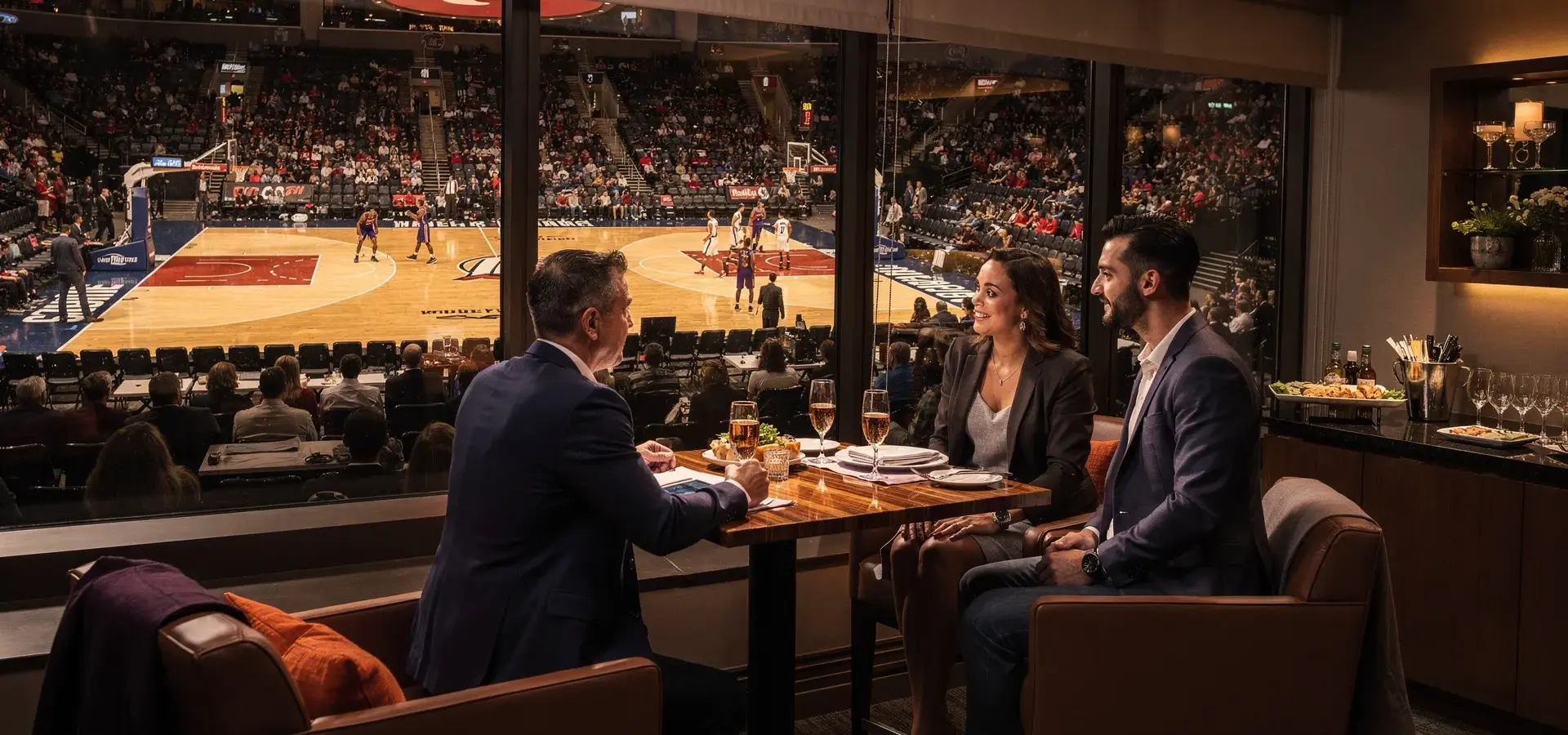
A private Phoenix Suns suite fits a 10-30-person client or partner event when private conversation, informal mingling, and a shared setting matter as much as watching the game. A private suite can provide an exclusive, intimate space for 8-30 guests to mingle and enjoy the game.
That setting gives you room to host the occasion as a group rather than split guests across separate rows. It can suit an executive gathering where you want clients, prospects, or partners to move between conversation and the action without making every interaction part of the game broadcast.
At LuxuryVIPSuites.com, we have been in business since 1992. We can help you turn the event date, guest count, and hosting requirements into a focused suite inquiry rather than treating the outing as a simple ticket purchase.
A suite is less compelling when your group mainly wants assigned individual seats, expects to arrive and leave independently, or does not need a private place to host. In that case, compare premium seating on a per-person basis before committing to a private format.
Use this first screen:
- Choose the suite path when privacy and group conversation are part of the business purpose.
- Continue comparing options when your guest list is uncertain or the event does not require shared hospitality.
- Keep the final decision tied to the specific game, guest count, and terms you need for approval.
Compare private hosting with other premium seating
A Phoenix Suns suite is more expensive than other stadium seats, although its per-person cost may be similar to club-level seating at the same view. That distinction matters for an executive host: you are comparing a private setting and a whole-event hosting format, not only the location of a seat.
Private suites offer flexible space, and most Phoenix Suns suites use first-come, first-served seating; suite seats provide a similar view of the action. The suite can therefore add value through how your group uses the space, while the game view may not be the only reason to choose it.
Use the following comparison to frame the internal conversation:
| Option | What to weigh | When to keep comparing |
|---|---|---|
| Private suite | Private space for guests to mingle, flexible use of the room, and a suite viewing experience | Keep comparing if the group does not need private hosting or if the total suite charge does not fit the approved occasion budget |
| Club-level seating | A per-person cost that may be similar to a suite at the same view | Compare the amount of private space and group interaction you would give up |
| Other stadium seats | A lower seat price than a suite in the general comparison | Compare this route when the business purpose is attendance rather than hosted conversation |
The practical question is whether the private environment changes the quality of the meeting enough to justify the premium. For a once-a-year client outing, that may depend on how many guests need to speak with you, whether the group will circulate during the game, and whether your company values a single setting over separate individual seats.
Write the approval case around the occasion, not around the word “luxury.” State who is attending, what conversations the event supports, and why a shared private space is useful. If you cannot explain that connection, request a comparison with club-level or other premium seating before selecting the suite.
Match the guest list to tickets and suite capacity
Suite tickets determine the maximum number of people who may enter the suite. You do not need to use every suite ticket, but no more people may enter the suite than the number of tickets purchased.
That rule affects both attendance planning and late additions. If you expect 18 guests but have only 16 purchased tickets, the extra two people cannot be treated as casual overflow. Ask for the ticket count, entry process, and any suite-specific access conditions in the quote.
Use this capacity check before you ask for approval:
- Count the people you expect to attend, including your own hosts.
- Mark which guests are clients, prospects, partners, or internal staff.
- Identify whether every expected attendee needs a ticket under the event’s entry rules.
- Compare the planned headcount with the suite’s stated capacity and purchased ticket count.
- Decide how much uncertainty you can accept if invitations are not yet final.
A private suite makes sense when the group can use the room together and the ticket count supports the planned attendance. If the guest list is likely to remain far below the available capacity, compare the per-person cost and interaction benefits with another seating arrangement.
Compare the hospitality details inside the suite
One listed private suite at Mortgage Matchup Center includes food and alcohol. Treat that as a feature of the listed suite rather than a standard inclusion for every suite you may consider, and ask for the exact food and beverage terms attached to your event.
Mortgage Matchup Center suites are climate-controlled and include a closet for coat storage. Those details can make arrival and movement easier for a business group, especially when guests are carrying jackets or shifting between the suite and the seating area.
The hospitality review should separate what is known about the venue from what belongs to a particular package. Ask for these details in writing:
- Whether food and beverages are included, available for pre-order, or charged separately.
- Whether alcohol service has event-specific conditions.
- How the seating is arranged and whether seats are first come, first served.
- Whether parking, attendant service, or other venue-day costs are separate.
- Which amenities belong to the specific suite offered to you.
Build the approval budget per guest
One published Phoenix Suns suite listing says the rental is due in full at purchase and ranges from $4,000 to $20,000 depending on the game. That range is useful context for an approval conversation, but it is not a substitute for the amount attached to the game and suite you are considering.
A suite price also needs to be translated into a cost per guest. Use the event-specific suite charge as the numerator and the number of expected attendees as the denominator. If the guest count changes, the per-person figure changes even when the suite charge does not.
Build the internal budget in separate lines so your approver can see what the headline figure includes:
- Suite rental: use the amount quoted for the selected Phoenix Suns game.
- Expected attendance: use the number of guests and hosts you reasonably expect to attend.
- Cost per guest: divide the suite rental by expected attendance.
- Included hospitality: list food, beverages, or other inclusions stated in the package.
- Separate costs: list anything the quote identifies outside the suite rental.
Do not divide the price by the invitation count if you expect several invitees to decline. Use the likely attendance number for planning, then show how the per-person amount would change if the final guest list is smaller or larger.
Other expenses can include gratuity for the suite attendant, parking, concessions, and Suns souvenirs. Include a line for each item that may affect your approval total, even if you do not yet know the amount.
The approval memo can then answer four straightforward questions:
- Who is the event for, and how many people are expected?
- What does the private setting add to the client-hosting purpose?
- What is the suite charge per expected guest?
- Which additional costs still need an amount or decision?
A clean budget does not require you to pretend that every amount is known at the planning stage. It requires you to label the suite charge, the arithmetic, and the open cost items separately so the decision-maker can see what still needs an answer.
Prepare the game-specific quote information
A useful Phoenix Suns suite inquiry starts with one defined game and one realistic attendance estimate. Give the request enough detail to answer the hosting question without making the person handling it reconstruct your event from a vague request.
Prepare these details before submitting the inquiry:
- Preferred Phoenix Suns game date, opponent if known, and venue: Mortgage Matchup Center.
- Expected party size, including client guests and internal hosts.
- Occasion: client entertainment, prospect hosting, partner meeting, or another business event.
- Preferred suite location or viewing preference, if your group has one.
- Seating needs, arrival expectations, and whether guests may arrive separately.
- Catering and beverage preferences, including questions about what is included.
- Parking, attendant, fee, and payment questions that affect the approval total.
- Company or client requirements involving invitations, gifting, attendance, or internal approval.
Ask the quote to distinguish the private-suite rental from everything else attached to the event. Request the suite capacity, number of tickets, entry instructions, seating arrangement, food and beverage terms, payment timing, and any identified taxes, fees, parking charges, or attendant costs.
A quote request is easier to evaluate when each question has a decision behind it. Capacity determines whether the guest list fits. Ticket and entry details determine who can arrive. Hospitality terms determine the occasion budget. Payment timing determines whether your approval process can keep pace with the event date.
Organize the request into non-negotiables and preferences. Non-negotiables for a Phoenix Suns suite inquiry can include the game date, the minimum ticket count needed for expected attendance, suite capacity, and any company or client rule that must be satisfied. Preferences can include suite location, viewing preference, catering details, or parking convenience. This separation lets an approver see which Phoenix Suns suite terms determine suitability and which details can be traded off during review.
Send the request only after you can state the event date, venue, party size, and occasion in the first few lines. Add the hosting requirements that could change the suite choice, such as a need for conversation space, a specific seating preference, catering questions, or a parking concern.
That brief gives you an answer you can take back to your CFO, event approver, or client-hosting contact. It also gives you a record against which to compare the capacity, access, inclusions, and total cost of the offered suite.
Check guest entry and venue-day requirements
Mortgage Matchup Center entry rules apply to Phoenix Suns game guests even when the group has a suite. For a Phoenix Suns game, children 36 months and older must have a ticket; children under 36 months may enter without one but must sit on a parent or guardian’s lap.
There is no age requirement for being in a Suns suite, but that does not remove the venue’s ticket and entry conditions. If a client event includes a child or family guest, identify the attendee’s age and ticket status before distributing the final instructions.
For non-Suns events, all attendees regardless of age must have a ticket. That distinction matters if you are using a venue suite for an event other than a Phoenix Suns game, so do not carry the Suns-game rule into another event without checking the applicable terms.
Backpacks, coolers, and other large bags are not permitted inside Mortgage Matchup Center, including for Phoenix Suns suite guests. Single-compartment drawstring bags, small purses, diaper bags, and other soft-side bags under 14"x14"x6" may be permitted after inspection.
Put the bag rule in the guest message instead of leaving it to arrival. Tell guests what they can bring, remind them that permitted bags may be inspected, and give them a contact point for questions about an unusual item.
Mortgage Matchup Center has no dress code for the suite level; corporate groups typically wear business casual, while team-branded apparel is also common. Give guests a simple expectation rather than prescribing a uniform, and make sure the host team follows the level of formality appropriate for the client relationship.
Before the event, place these items on your arrival checklist:
- Final ticket count and names or distribution plan.
- Entry instructions for the suite and the venue.
- Bag restrictions and the 14"x14"x6" soft-side limit.
- Arrival timing, parking questions, and guest contact information.
- Any event-specific access or hospitality instructions included with the quote.
Resolve the terms before seeking approval
Your approval packet should pause when a material event term remains unclear. A low headline price does not answer whether the suite has enough tickets, whether the guest list fits, or whether the hospitality package supports the occasion you described.
Resolve these points before presenting the option as ready:
- The game date, venue, suite capacity, and number of tickets.
- Who may enter and how guests receive or use their access.
- Seating location, first-come seating conditions, and the practical use of the room.
- Food and beverage inclusions, catering arrangements, and any separate charges.
- Payment timing, taxes or fees identified in the quote, parking, and attendant costs.
- Company and client requirements for hosting, invitations, gifting, or approval.
Use a simple internal decision such as “approve,” “request clarification,” or “compare another seating format.” Choose “approve” only when the guest count, event purpose, budget arithmetic, and access plan line up. Choose “request clarification” when one missing term could change the decision. Choose “compare” when the private setting does not add enough value for the cost or when another format better matches the group.
Keep the explanation factual. State the event purpose, the expected attendance, the cost-per-guest calculation, the included hospitality, and the open questions. That gives your approver a defined choice rather than a general request to buy premium seats.
Company approval and client-hosting rules belong in the decision record, especially when the event involves prospects, partners, or high-value relationships. If an internal policy limits invitations, gifts, alcohol, or attendance, route the proposed event through the person responsible for that policy before you commit to the suite.
Do not let an unresolved compliance or access question become a venue-day problem. Record the question, identify who must answer it, and keep the event in the comparison stage until the material term is clear.
Move from a defined event brief to the next step
A Phoenix Suns suite is a reasonable option when your client or partner event needs a private place for 10-30 people to meet, mingle, and watch the game together. The decision becomes easier when you connect the guest list to suite capacity, separate the rental charge from additional costs, and compare the hospitality details with the purpose of the outing.
Before you move forward, have the game date, venue, party size, occasion, seating preferences, catering questions, parking concerns, and approval requirements in one brief. Price, inventory, and inclusions are confirmed per event, so use the event-specific response to finish the budget and access review.
At LuxuryVIPSuites.com, we can use that defined brief to focus the next conversation on the suite that fits your intended group and hosting plan. A qualified professional should decide whether the event is suitable for your organization’s individual compliance and approval requirements.
What should you confirm before accepting a Phoenix Suns suite quote?
How much does a Phoenix Suns suite cost?
One published Phoenix Suns suite listing gives a range of $4,000 - $20,000, depending on the game, with payment due in full at purchase. For approval, divide the event-specific suite charge by expected attendance and account separately for possible gratuity, parking, concessions, and other fees.
Are food and drinks included in a Phoenix Suns suite?
Inclusions vary by suite and event. One listed Mortgage Matchup Center suite includes food and alcohol, but you should confirm whether the specific option includes catering, beverages, alcohol service, or separately priced items before approving the outing.
How many guests can a Phoenix Suns suite accommodate?
Private suites can provide space for 8-30 guests, but the actual capacity and ticket count depend on the specific suite. No more people may enter the suite than the number of tickets purchased, even though you do not have to use every ticket.
What payment detail should I confirm before booking a Suns suite?
Ask whether the quoted amount is due in full at purchase and identify any taxes, fees, parking charges, gratuity, or other costs outside the suite rental. One published listing states that payment is due in full at purchase, so your approval process should account for that timing if it applies to the offered suite.
What should I confirm before accepting a Phoenix Suns suite quote?
Confirm the game date, suite capacity, ticket count, entry and access instructions, seating arrangement, food and beverage inclusions, payment timing, parking, fees, and any company or client-hosting requirements. These details determine whether the guest list fits, the budget is complete, and the event can proceed as planned.
Hosting a group?
Tell us the date and the headcount
We get back to you within one business day with what is available and what each suite costs.
Request a quote