
are luxury suites a good option for corporate networking?
are luxury suites a good option for corporate networking?
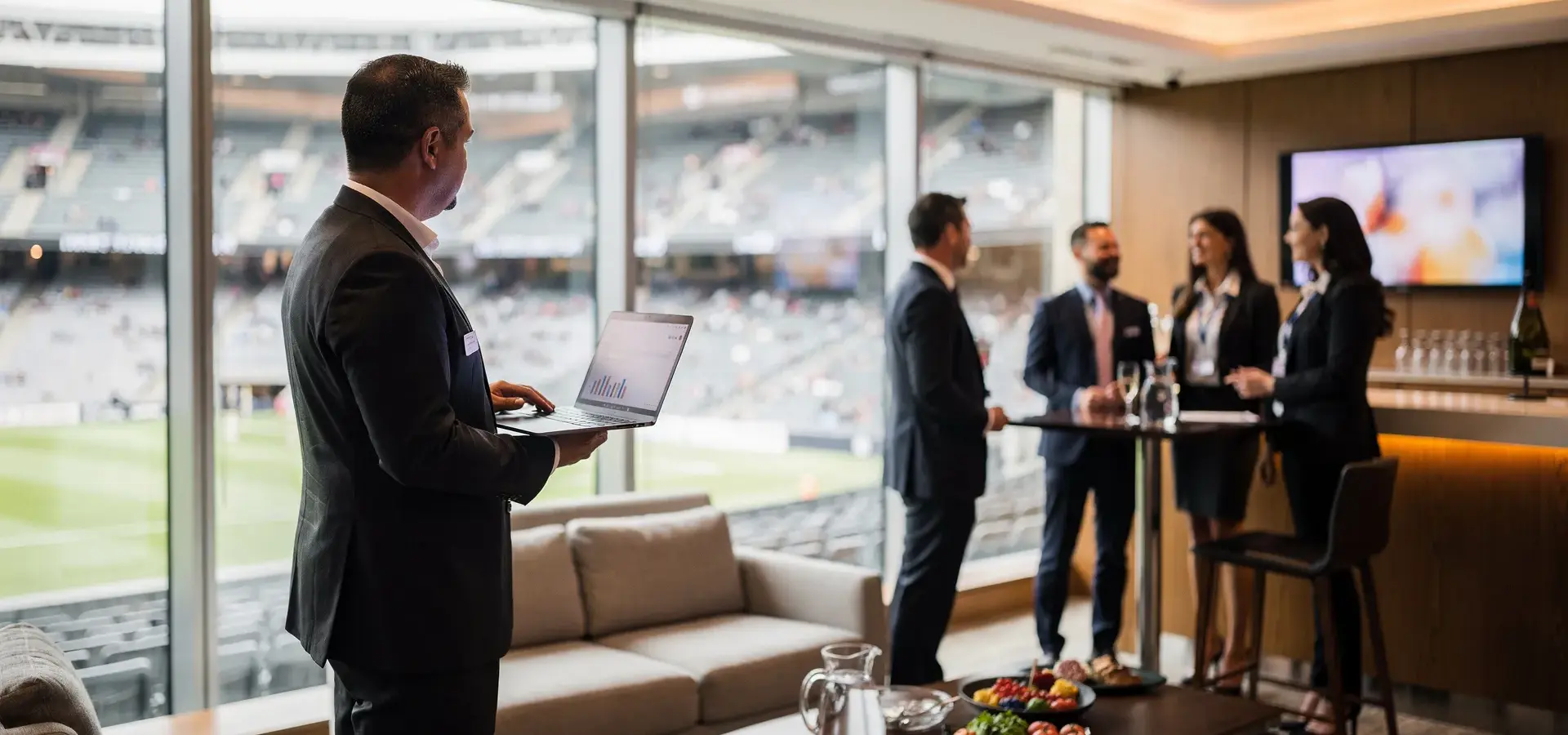
Make the networking decision first
A luxury suite fits corporate networking when private conversation, hosted introductions, and a defined guest group matter more than broad interaction with the surrounding crowd. Choose a more open or lower-commitment format when your goal depends on meeting people outside your invited group, your attendance is small, or you need each guest to buy an individual ticket.
A private suite also makes you responsible for the whole-space decision: the group size, seating arrangement, hospitality package, and total event cost must work together. Judge the format by the networking objective first, then test privacy, guest movement, capacity, and cost per guest before seeking approval.
A corporate hospitality suite is a private, reserved space where you can host clients, partners, or employees, while a luxury suite is a private enclosed venue space rented or leased as a single unit. That arrangement gives you a defined setting for introductions, conversation, food, and breaks from the main event without requiring your group to share the room with unrelated ticket holders.
At LuxuryVIPSuites.com, we have been in business since 1992. Weigh that setting against the interaction pattern you need: a contained space can make conversations easier to host, but it can also narrow contact to the people you invite.
Use privacy to create better conversation conditions
Privacy gives your host team more control over the conditions for conversation. Private suites can offer controlled access, indoor and balcony seating, climate control, private restrooms, dedicated service, catering capability, and display or audio systems; they may be leased annually or rented per event. Those features can let you move between conversation, food, the live event, and a quieter exchange without leaving the hosted space.
Suites also add comfort and exclusivity to the traditional game experience and may provide upscale food and beverage menus and technology for following the game or conducting business meetings. The practical benefit for networking is a setting where you can welcome guests, make introductions, and give people room to continue a conversation instead of managing the entire event from a public concourse.
Connecting with clients outside an office environment can show different sides of your business and may help clients share their thoughts and opinions more freely.
Use the enclosed format deliberately. Plan who will greet each guest, which introductions need to happen early, where people can stand or sit, and when you want to bring attention back to the game or concert.
Test the guest list and hosting brief
Your guest list should determine whether you need a private suite, a smaller premium format, or a different event setting. Separate guidance places private suites at 10 to 20 guests and recommends club seats or shared suites for groups of 2 to 8 guests.
Use those ranges as an initial screen, not as the entire decision. Count confirmed guests, likely additions, hosts, and people who may arrive late. Then ask whether your group needs a fully private setting, a place to circulate, or simply upgraded seats around a shared lounge.
Your hosting brief should answer four questions before you compare prices:
- What relationship are you developing: clients, prospects, partners, employees, or a mixture?
- Does the event need private conversation, informal introductions, a presentation, or several of those activities?
- How much movement do you want between seats, the suite, the balcony, food service, and the event itself?
- Does the room need a microphone, screen, presentation connection, remote-participant setup, or another technical feature?
Raise every technical requirement during planning, before choosing the room. A suite may provide display or audio equipment, but the specific setup belongs in the event brief rather than in an assumption about the venue.
A party suite typically offers a larger event space for entertaining more people in a suite setting. That format may fit a broad internal gathering or a larger guest mix better than a conventional private suite, while a compact group may benefit from a smaller semi-private option.
Match the room to the event purpose. A client dinner-style conversation, a prospect introduction, an employee appreciation outing, and a product presentation place different demands on privacy, circulation, seating, and technology. Write the purpose in one sentence so your approver can see why the selected format fits the guest list.

Design how guests will move and interact
Your networking plan should give guests more than a place to stand. Use a simple sequence that creates movement without making the event feel programmed:
- Welcome each guest and make the first introduction at arrival.
- Group early conversations around a shared topic, client need, or event moment.
- Leave enough unstructured time for guests to move between seats, food, the suite area, and the view.
- Reconnect people who have a useful reason to continue talking.
- Close with a clear host thank-you and a practical follow-up point.
The host should circulate rather than stay fixed with the first group that arrives. A second host can watch the arrival flow and make introductions, especially when the guest list includes clients, prospects, and internal attendees who do not already know one another.
SRO tickets can allow extra guests to stand and socialize in a suite and are exclusively available to suite holders rather than the general public. Treat that option as a separate attendance question: ask how many tickets are included, how many additional tickets may be available, where those guests may stand, and whether the added people change the usable space for seated guests.
Extra attendance can help a networking event breathe when people are expected to circulate, but it can also make a compact room harder to manage. Base your plan on the seating and standing arrangement offered for the specific event, then decide whether the additional access supports your interaction design or simply increases the headcount.
A private suite can give a group of eight to thirty people a setting to mingle and talk in privacy, but controlled access also limits contact with people outside the invited group. That trade-off is useful when you already know whom you want to host and less useful when discovery depends on meeting a wider event audience.
Choose the guest flow before choosing the package. If your priority is confidential discussion and planned introductions, keep the group contained. If your priority is broad circulation, compare the suite with club access, shared hospitality, or another format that places guests closer to common areas.

Choose the right level of enclosure
Your format choice should follow the level of privacy, circulation, group size, and hosting control that the event requires. The comparison below keeps those criteria together so you can explain the choice to an approver.
| Format | Privacy and circulation | Group fit | Hosting control |
|---|---|---|---|
| Private suite | Fully private group space with controlled access; conversation stays within the invited setting | Private-suite guidance places this format at 10 to 20 guests, while luxury suites generally accommodate 10 to 30 guests | High control over introductions, food, seating, and the hosted environment |
| Club seats | Upgraded individual seating with access to shared lounges and amenities | Guidance recommends club seats or shared suites for groups of 2 to 8 guests | Lower room control, with more connection to shared venue spaces |
| Loge box | Semi-private, suite-like setting rather than a fully enclosed private suite | Typically designed for 4 to 6 people | Moderate control for a small group and a more compact conversation setting |
| Party suite | Larger suite event space for entertaining more people | Useful when the event needs more room within a suite setting | More room for a broad hosted gathering, subject to the event arrangement |
Use individual ticket-by-ticket seating as a comparison point when your group is small or when shared venue access matters more than a private room. Do not compare only the ticket price: compare the interaction pattern and the work required from the host.
Choose a private suite when your event depends on planned introductions, private conversation, and a defined group that can use the full-space commitment. Choose club seats or shared hospitality when the group is smaller or when access to common lounges matters more than controlling the entire room.
Choose a loge box when four to six people need a semi-private setting and a full suite would create more space than the event needs. Choose a party suite when the group needs a larger event area for entertaining more people. Put the selected branch and its reason in the approval note.
Your comparison should also account for what guests experience between conversations. A private suite can keep the group together, while club seating connects guests to shared lounges and amenities; a loge box offers a smaller semi-private setting, and a party suite provides more event space. The right choice depends on whether privacy, circulation, compactness, or room to host carries the most weight.
Once you choose the format, carry that decision into the cost calculation. A lower total is not useful if the seating, capacity, or interaction pattern cannot support the event objective.
Turn the suite total into an approval number
Your approval number should show the whole-suite total and the cost per expected guest. Use this calculation:
Cost per guest = complete quoted event total ÷ expected attendance.
Use the complete amount shown for the event, including any listed catering, service charges, taxes, fees, or other required lines. Then run the calculation twice if attendance is uncertain: once for the confirmed group and once for the realistic expected group. The lower per-guest figure from a larger headcount should not become the approval basis unless those guests are likely to attend.
Private-suite pricing varies by matchup, venue, suite location, and included amenities. Compare the same cost categories across the suite, individual tickets, club seats, loge seating, and shared hospitality so that the whole-space commitment does not look cheaper simply because another option has been quoted in a different format.
Suites typically offer better value per person for groups, especially for high-demand games and concerts. Treat that statement as a reason to calculate rather than as a conclusion: your result depends on the event, the expected attendance, the package lines, and the alternatives available for that date.
Your approval note should show four numbers or inputs:
- Complete suite total.
- Expected attendance used in the division.
- Cost per guest.
- Comparable total and cost per guest for the alternative format.
Add a short explanation of what the private setting contributes to the networking objective. That lets the approver weigh the hospitality format alongside the arithmetic instead of treating the suite as a ticket bundle with no hosting purpose.
The 84.02% figure measures the share of all venues in one industry reference that list suites on a per-event basis. A per-event listing may make a single networking occasion easier to evaluate than a season commitment, but the event terms still determine what you receive.
The 41.40% figure measures the share of all teams in that same reference that include food and beverage in the cost of a per-event suite. Food and beverage may be included in an event-suite price, but inclusion varies by team. Put catering, beverage service, taxes, fees, and ordering requirements on separate lines in your comparison rather than treating them as automatic inclusions.
Your cost-per-guest result is sensitive to attendance. A suite may look efficient with a full guest list and expensive when several invitees decline, so show the assumption plainly and identify who owns the attendance estimate.
Your decision should also account for the cost of hosting work. If the private setting lets your team spend the event with guests instead of coordinating a public gathering, that operational difference belongs in the written rationale. Keep the rationale concrete: name the conversation format, the guest relationships, and the inclusions that support the event.

Prepare a quote brief that answers the decision
Your quote brief should give the booking team enough information to evaluate fit, capacity, hospitality, and cost in one pass. We contract directly with suite owners across North America to provide suites in the secondary marketplace, so describe the event rather than asking for a generic suite price.
Include these core details:
- Venue, event, preferred date, and acceptable date range.
- Expected attendance, confirmed attendance, and any likely additions.
- Guest mix, relationship objectives, and the level of privacy you need.
- Seating, balcony or indoor preferences, and the amount of guest circulation expected.
- Complete budget target and the cost-per-guest figure you need to defend.
- Any catering, beverage, parking, club or lounge access, private entrance, service, or technology requirements.
Your event questions should be specific enough to produce an answerable package:
- What capacity and ticket count apply to the suite for the selected event?
- What is the seating arrangement, and how do indoor, balcony, standing, and circulation areas work?
- Which catering and beverage items are included, optional, or billed separately?
- Are private entrances, parking, club or lounge access, dedicated service, displays, and audio systems included?
- Can SRO tickets be added, and how would additional guests use the space?
- What is the complete event total, and which fees or required charges are included in that number?
- What payment schedule, cancellation terms, and contract conditions apply?
Raise any microphone, screen, presentation connection, remote-participant setup, or other technical requirement before choosing the room. A technical need that appears after the room is selected can change whether the format works for your event.
Your internal approval record should preserve the answer to each question, not just the headline price. Record the suite capacity, usable attendance, seating layout, hospitality inclusions, optional lines, extra-ticket rules, payment terms, cancellation language, and contract conditions beside the cost-per-guest calculation.
Use the record to compare alternatives on the same basis. If a club-seat or shared-hospitality option includes access that the suite does not, or if a suite includes hospitality that individual tickets do not, show those differences before presenting the recommendation. A complete brief makes the decision about the event you are actually planning.
Seek professional evaluation when key terms stay unresolved
Your approval process should pause when the quote leaves a material part of the event arrangement unclear. Escalate the brief for review when any of these conditions remains unresolved:
- Capacity, ticket count, or seating access does not match the expected attendance.
- Catering, beverage service, fees, or other inclusions are described without a clear cost line.
- The total price cannot be reconciled with the cost-per-guest calculation.
- Payment timing, cancellation terms, or contract language is incomplete.
- A required screen, microphone, presentation connection, remote-participant setup, or other technical feature is not defined.
- The proposed room does not support the privacy or circulation pattern in the networking plan.
Ask the responsible procurement, finance, event, or contract reviewer to resolve the specific open term. Do not approve a package simply because the headline total fits the budget.
Your decision record should name the unresolved point, the person responsible for answering it, and the condition that must be met before approval. That approach keeps a low price from obscuring a capacity problem and keeps an attractive room from obscuring missing hospitality or contract details.
Proceed when the guest fit, interaction design, complete cost, inclusions, and contract terms align. If one of those elements still conflicts with the event brief, return to the format comparison instead of forcing a private suite into the plan.
Move from a defined networking brief to the next step
A luxury suite is a practical networking choice when your event needs private conversation, planned introductions, and a defined group large enough to use the space. A more open or smaller-format option fits better when broad circulation, individual attendance, or shared venue access matters more than controlling the room.
Use your guest list, interaction plan, format comparison, and cost-per-guest calculation to make the recommendation defensible. Price, inventory, and inclusions are confirmed per event. A qualified professional or responsible internal reviewer should resolve individual suitability and any unresolved contract or approval issue before you proceed.
A defined brief gives LuxuryVIPSuites.com the event, guest, hospitality, and budget context needed for the next evaluation. If the privacy, guest fit, movement plan, and complete cost align, continue with LuxuryVIPSuites.com.
What should you confirm before requesting a corporate suite quote?
Are private suites suitable for a small corporate networking group?
They may be inefficient when attendance is small because the suite is rented as a whole space. Groups of 2 to 8 may fit club seats or shared hospitality more naturally, while private-suite guidance generally focuses on groups of 10 to 20; confirm the event-specific capacity and total cost before choosing.
Is catering included in a corporate suite price?
Sometimes, but it varies by team and event. Ask for catering, beverage service, taxes, fees, ordering requirements, and any minimums as separate quote lines so the cost per guest reflects the complete event total.
Can extra guests be added to a private suite?
SRO tickets may allow additional guests to stand and socialize in the suite, but availability and use depend on the event arrangement. Ask how many tickets are included, whether more can be added, where those guests may stand, and how the added attendance affects usable space for seated guests.
Hosting a group?
Tell us the date and the headcount
We get back to you within one business day with what is available and what each suite costs.
Request a quote