
chicago bulls suites
Chicago Bulls Suites: A 15-30-Person Company Outing Decision Guide
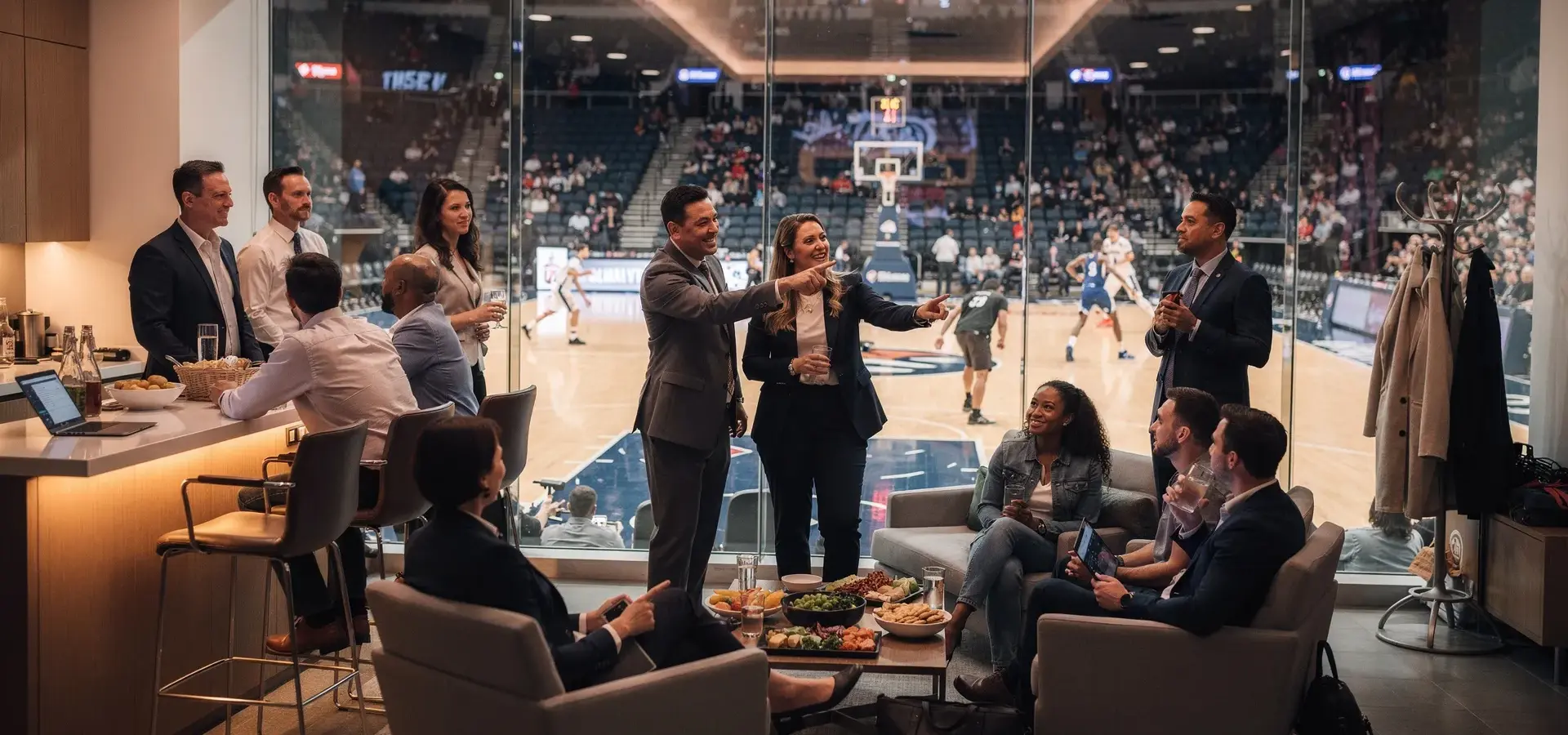
Turn the Bulls outing request into an approval decision
For a 15-24-person Chicago Bulls outing, a private suite can fit the group in one room; for 25-30 employees, treat the upper end as a capacity question and compare a larger group-seating arrangement before seeking approval. Your decision should rest on four items: whether the format fits the headcount, what the total quoted cost means per guest, which hospitality items are included, and which event terms could affect the company’s commitment.
At LuxuryVIPSuites.com, we have been in business since 1992. The practical next step is to turn the outing request into a short approval brief rather than asking for a generic suite price. Name the game and date, state the expected attendance, explain the hosting purpose, and list the food, beverage, parking, invoice, and date-change questions your approver will ask.
A private room may make sense when your group needs a shared setting for employee interaction, client hosting, or a planned meal. Club-level or other group seating may fit better when the priority is keeping people in conventional arena seats or controlling the hospitality spend separately. Neither choice can be judged from a headline price alone; the quote has to show the capacity, package contents, and financial terms together.
Use this sequence for the approval conversation:
- Start with the smallest credible format for the actual headcount.
- Divide the complete quoted suite cost by the number of attendees you expect to bring.
- Separate included food, drinks, and parking from items ordered or paid for separately.
- Record refund, exchange, cancellation, and date-change conditions before your company commits.
- Send the resulting brief with the event date, venue, party size, and requirements.
Screen 15-30 employees against private-suite capacity
A Chicago Bulls suite at United Center holds 12-24 guests and is rented as one private room. That range gives you a straightforward first screen: a 15-person group falls inside the stated capacity, while a 25-30-person group exceeds the stated 24-guest range and needs another arrangement or explicit confirmation of how the group would be accommodated.
A separate listed suite includes 12-14 stadium-style seats, 4 barstools, and standing room. Ask for the ticket count, usable seating, and permitted occupancy for the exact suite under consideration.
The smallest suites fit a group this size comfortably. Read that statement alongside the 12-24-person range: it supports a comfortable fit for the lower part of your 15-30-person planning range, but it does not settle the 25-30-person case. A 15-person group should ask whether the smallest room gives enough seating and circulation for the way you plan to host. A 24-person group should ask whether the room’s ticket and seating layout works for everyone without relying on assumptions about standing room.
Twelve guests in a 40-seat football suite can feel empty. That comparison matters because an oversized room may create a less focused gathering even when it technically has enough capacity.
Before you choose a room, write down:
- Expected attendance, with a minimum and maximum if the guest list is still moving.
- Number of ticketed seats, barstools, and any standing area described in the offer.
- Whether every employee receives the same suite or arena access.
- Whether the room is private for your group and whether the quoted capacity is 12-24 guests or another event-specific figure.
The decision boundary is simple: 15-24 people can be screened against the cited private-room range; 25-30 people should not be treated as an automatic single-suite fit.

Compare private suites, club-level seats, and group seating
Private suites, club-level seats, and other group-seating arrangements solve different hosting problems. The right choice depends on whether your outing needs a private gathering space, conventional seat-by-seat viewing, separate control of food and drinks, or room for a group larger than the cited private-suite range.
| Format | Group-fit question | Hospitality and service question | Approval use |
|---|---|---|---|
| Private suite | Does the exact room and ticket count cover your 15-24-person group, or can the event support your larger headcount? | Does the package provide the private setting and the food, drinks, parking, and service your host plan requires? | Use when privacy and shared hosting are central to the outing. |
| Club-level seats | Can you place the whole group together or in an acceptable seating pattern? | Club-level seats are typically between the lower and upper bowls, with wider seats and access to club-level concessions, but traditional club-level tickets generally require separate purchases for food, drinks, and in-seat service. | Use when arena seating and a separate hospitality budget fit the approval plan. |
| Group seating | What ticket count and seating pattern are available for the full 15-30-person group? | Which amenities, food arrangements, and parking terms attach to the selected offer? | Use when a single private room does not fit the headcount or the company prefers a simpler seating format. |
The described Chicago Bulls suites include modern décor, wide theater-style seating, a wet bar, high definition televisions, and wifi. Many suites feature private restrooms; small boxes have restrooms near the suite, and all suites are climate-controlled. Those features can support a hosted gathering, but they should be listed as package details rather than treated as a reason to ignore capacity or cost.
Club-level seating creates a different operating plan. Wider seats and access to club-level concessions may suit an outing centered on watching the game from assigned seats. Traditional club-level tickets generally do not include food, drinks, or in-seat service, so your budget should show those purchases separately rather than comparing a club ticket with a suite total that includes hospitality.
Use the private-suite path when the group needs one room for introductions, conversation, or planned service. Use club-level seating when the group’s main requirement is premium arena seating and the company is comfortable handling food and drinks separately. Use another group-seating arrangement when the headcount exceeds the private-room screen or when the approval target depends on a ticket structure rather than a room.
Estimate the total cost per guest from the quoted price
A Chicago Bulls suite is rented as one private room, so your first approval calculation should start with the total quoted suite amount and divide it by the number of attendees. The price depends on the game, the suite, and the day of the week. United Center suite pricing also varies by event type, opponent or artist, and suite level.
Use this formula in your internal budget:
Total quoted suite price ÷ expected attendees = preliminary cost per guest
Run the calculation twice if attendance is uncertain. A 15-person group produces a higher cost per guest than a 24-person group at the same total price, and a 30-person planning number should not be used to make a private suite appear affordable if the room cannot accommodate that group.
A United Center premium package is priced at $10,750 - $16,075, varying by game. That package’s amount is not a fixed price for every Chicago Bulls event. As a mathematical screen only, the lower amount divided among 15 attendees is about $716.67 per guest, while the lower amount divided among 30 attendees is about $358.33 per guest. The upper amount divided among 15 attendees is about $1,071.67 per guest, while the upper amount divided among 30 attendees is about $535.83 per guest.
Those calculations help you explain the range to an approver, but they do not establish availability, capacity, food and beverage coverage, parking, taxes, fees, or contract terms. They also do not make 30 attendees a suitable private-suite headcount. Keep the arithmetic separate from the event decision:
- Record the quoted total exactly as presented.
- Divide it by the conservative attendance number, not the hoped-for maximum.
- Add separately priced catering, drinks, parking, fees, and other required items when the offer identifies them.
- Show a second per-guest figure if the attendance range materially changes the approval case.
- Ask whether the price is for the whole suite, a package, or another seating structure.
Your approval email can then say, for example, that the preliminary cost per guest is based on the complete quoted total and a stated attendance assumption. That wording makes the calculation easy to revise when the date, suite, game, or guest list changes.
Check food, drinks, parking, and package inclusions
Food and beverage terms can change the cost comparison more than the room description does. Food and beverages can be ordered before the event for delivery to the suite or during the event from a suite attendant. Catering is not included in that suite’s reservation cost, although it can be ordered in advance or from the attendant after arrival.
A United Center premium package includes a Classic Menu Package with the rental, a 4-hour open bar with beer and wine, and 4 Reserved Parking Passes. Those inclusions apply only to that package. Do not transfer them automatically to another suite, game, or date.
Put the following lines into your comparison sheet:
- Food: included menu, advance catering, event-day ordering, or no stated arrangement.
- Drinks: included beverage package, beer and wine terms, separate ordering, or no stated arrangement.
- Parking: number of passes and whether they match your expected driving needs.
- Service: delivery timing, suite attendant availability, and any service charges shown in the offer.
- Fees: taxes, delivery charges, gratuity, facility charges, or other additions identified in the quote.
- Guest handling: ticket distribution, arrival instructions, and the person responsible for coordinating the group.
The food question should be specific. Ask whether the quoted menu covers every attendee, whether dietary requests can be handled, when advance orders must be placed, and whether event-day ordering changes the price or available choices. The beverage question should identify what is included, how long service lasts, and whether nonalcoholic options are part of the package.
Your company may decide that most guests will use another form of transportation, but that should be an intentional event decision rather than an assumption hidden inside the suite price.
Before approval, make the package comparison readable to someone who was not involved in the research. Show the suite total, the included items, the separately ordered items, the number of parking passes, and every unresolved charge in adjacent rows. That format lets your approver see whether two offers differ in price, hospitality, or both.

Prepare the event brief for an answerable quote
An answerable Chicago Bulls quote starts with the event, date, and party size. Dates are quoted individually, so a request that names only the team and a general month leaves too much of the decision open.
Prepare one short event brief with these fields:
- Event: Chicago Bulls game, with the opponent if known.
- Date: preferred game date and any acceptable alternate dates.
- Venue: United Center, Chicago.
- Party size: expected attendance, plus the smallest and largest realistic headcount.
- Format: private suite, club-level seats, or another group-seating option.
- Purpose: employee outing, client hosting, team celebration, or another business use.
- Budget: target total and the cost-per-guest level your approver can review.
- Hospitality: desired food, beverage, service, and seating arrangements.
- Parking: number of passes needed and whether most guests will arrive separately.
- Administration: invoice requirements, company name, guest-list handling, and the person approving the purchase.
- Terms: questions about fees, refunds, exchanges, cancellations, date changes, and what happens if attendance changes.
The party-size field should not say only 15-30 employees. Give a working number, such as 18 expected with a possible range of 15-22, if that is what your planning team knows. A precise headcount lets the quote be assessed against the 12-24-person private-room range and prevents the cost-per-guest calculation from using an unexplained denominator.
The format field should also explain what you want to compare. You might ask for a private suite and a club-level or group-seating alternative for the same game, or you might state that privacy is required and ask which suite capacities fit the group. The point is to make the decision criteria visible before price enters the discussion.
Add your deadline for internal approval and the date by which you need an answer. If alternate dates are acceptable, list them in order.
Finish the brief with a clear list of unanswered questions rather than a general request for details. That gives the person handling the inquiry a usable starting point and gives your approver a record of what still needs an answer.
Resolve timing, refund, and date-change exposure before approval
A Chicago Bulls suite request should reach the quote stage with enough time for capacity, package, and approval questions to be answered. Plan on about 4 weeks of lead time, and place that planning point beside your company’s approval deadline rather than waiting until invitations or travel plans are already fixed.
The United Center handbook states that, once Premium Seating Members have purchased tickets to other events or additional Bulls or Blackhawks suite tickets, there are no refunds or exchanges. That condition applies to the described Premium Seating Members transaction; it should prompt you to ask which refund, exchange, cancellation, and date-change terms apply to the specific offer your company is considering.
The same policy describes access through both a mobile event ticket and a mobile obstructed-view suite pass. Treat that as an event and ticket condition to understand before distributing arrival instructions, not as a universal rule for every suite arrangement.
Put these questions in writing before approval:
- What happens if the game date changes or the company needs to move the outing?
- Are refunds, exchanges, or credits available, and under what conditions?
- When does the company become financially committed?
- Can the guest list or ticket assignment change after purchase?
- Who receives the mobile tickets, parking passes, and any required access pass?
- What arrival time and access process should you send to employees?
- Which terms apply if the suite has an obstructed view or a package-specific restriction?
Ask for the answers in the same document as the total price and inclusions. A low preliminary cost per guest does not resolve the risk created by a restrictive transaction term, and a generous package does not solve a date that your company cannot approve in time. Your internal decision should account for both the event experience and the company’s ability to manage a change.
Get the unresolved event terms evaluated before committing
An event quote is ready for approval only when your company can identify the selected format, the expected attendance, the complete financial commitment, and the operating conditions attached to the offer. If any of those items remains unclear, keep the decision open and return a focused question rather than filling the gap with an assumption.
Use this final review before anyone confirms the outing:
- Fit: Does the proposed room or seating arrangement cover the expected group without relying on an unconfirmed capacity?
- Cost: Does the total include every required item, and is the cost per guest based on a stated attendance number?
- Hospitality: Are food, drinks, service, and parking included, separately ordered, or unresolved?
- Operations: Does your team know how tickets, guest details, parking passes, and arrival instructions will be handled?
- Terms: Are refund, exchange, cancellation, and date-change conditions clear enough for your company’s approval process?
- Timing: Can the decision be made with enough lead time for the quote and internal review?
Send the questions to the person handling the event inquiry and give your authorized approver the revised answers in the same approval packet. If the proposed private room does not fit the final headcount, compare club-level or group seating before treating the event as unworkable. If the package terms remain unclear, postpone the commitment until the relevant commercial and operational details are written down.
Submit the completed Bulls event brief for a private-suite quote
Your completed approval brief should carry the selected game and date, venue, expected attendance, private-suite or group-seating preference, cost-per-guest calculation, hospitality questions, parking needs, and transaction terms. That information gives LuxuryVIPSuites.com a clear basis for the next conversation instead of leaving capacity, inclusions, or budget assumptions unstated.
At LuxuryVIPSuites.com, we need the event date, venue, party size, and requirements to work from that brief. Pricing, inventory, and inclusions are confirmed per event, so your company should approve the outing only after those event-specific details are clear. Individual suitability and the final contract decision should be handled by the appropriate qualified professional or authorized company approver.
What should a planner confirm before requesting a Chicago Bulls suite quote?
Can I book a private Chicago Bulls suite for 20 employees?
A 20-person group falls within the cited 12-24-guest range for a private United Center suite rented as one room. Confirm the exact ticket count, usable seating, occupancy, and package terms for the selected game; groups of 25-30 should be evaluated against another group-seating option or explicitly confirmed as a larger arrangement.
Is catering included in a Chicago Bulls suite rental?
It depends on the specific package. Catering is separate from one suite’s reservation cost, while food and beverages can be ordered before or during the event; another United Center premium package includes a menu, a four-hour beer-and-wine open bar, and four reserved parking passes. Ask for the selected event’s food, beverage, parking, fees, and service terms in writing.
What should I confirm about a Bulls suite if the game date changes?
Ask when your company becomes financially committed and whether refunds, exchanges, credits, cancellations, or date changes are permitted. United Center’s handbook says some Premium Seating Member purchases have no refunds or exchanges, so the terms for the specific offer should be reviewed before payment and before invitations are sent.
How should I calculate the cost per guest for a Bulls suite?
Divide the complete quoted suite or package total by the expected number of attendees, then list separately priced catering, beverages, parking, taxes, fees, or service charges. Use a conservative attendance number for approval and confirm whether the offer is for the whole private room, individual seats, or another structure.
Hosting a group?
Tell us the date and the headcount
We get back to you within one business day with what is available and what each suite costs.
Request a quote