
kings suites
Kings Suites: A Decision Guide for Identifying the Right Team, Game, and Quote
Which Kings team and game are you considering?
The phrase Kings suites can refer to two different teams: the Los Angeles Kings and the Sacramento Kings. Their venues, games, pricing references, suite terms, and event details are not interchangeable. Start by identifying the team before you assess a private suite for a client group, company outing, or personal sports experience.
Your first planning task is to create a specific event record:
- Team: Los Angeles Kings or Sacramento Kings
- Game: opponent, event date, and start time when known
- Venue: the venue shown for that specific event
- Group: expected party size and whether attendance may change
- Purpose: client hosting, employee entertainment, networking, celebration, or a game-day experience
That short record prevents a common planning error: comparing a Sacramento reference with a Los Angeles event or treating a general suite label as if it describes one fixed package.
A private suite decision should answer three questions in order: which event you mean, whether private hospitality fits the group, and which terms must appear in an event-specific response. The answer does not begin with a price range. It begins with the correct team and game.
If you are still deciding between the two Kings teams, keep separate notes for each option. If you already know the team, record the venue and date before asking about suite size, amenities, or cost.
Separate the Los Angeles Kings and Sacramento Kings paths
The Los Angeles Kings path requires an event-specific venue and game record before you compare suite terms. A Los Angeles Kings suite listing describes pricing by opponent, day of the week, time of season, suite size, and suite location, with prices able to fluctuate during the season. Use the event listing for the particular game to identify the applicable venue, date, and opponent rather than carrying details over from a Sacramento event.
For a Los Angeles Kings inquiry, write down:
- The exact game and date
- The venue shown for that game
- The expected party size
- The purpose of the outing
- The suite characteristics that matter to your group
- The budget boundary you need the response to address
This path is appropriate when your event brief points to a Los Angeles Kings game. It is not a substitute for identifying the game itself.
The Sacramento Kings path uses Golden 1 Center as the venue reference in the cited premium-rental listing. That listing describes Sacramento Kings game pricing as dependent on the specific rental space, tickets, location, and opponent. Keep those details with the Sacramento record rather than using them to estimate a Los Angeles Kings event.
For a Sacramento Kings inquiry, record the Golden 1 Center event, the opponent, the date, the group size, and the occasion. Then treat the listing’s pricing and inclusion language as a starting point for questions about the specific suite and game.
Your team choice determines the next useful question:
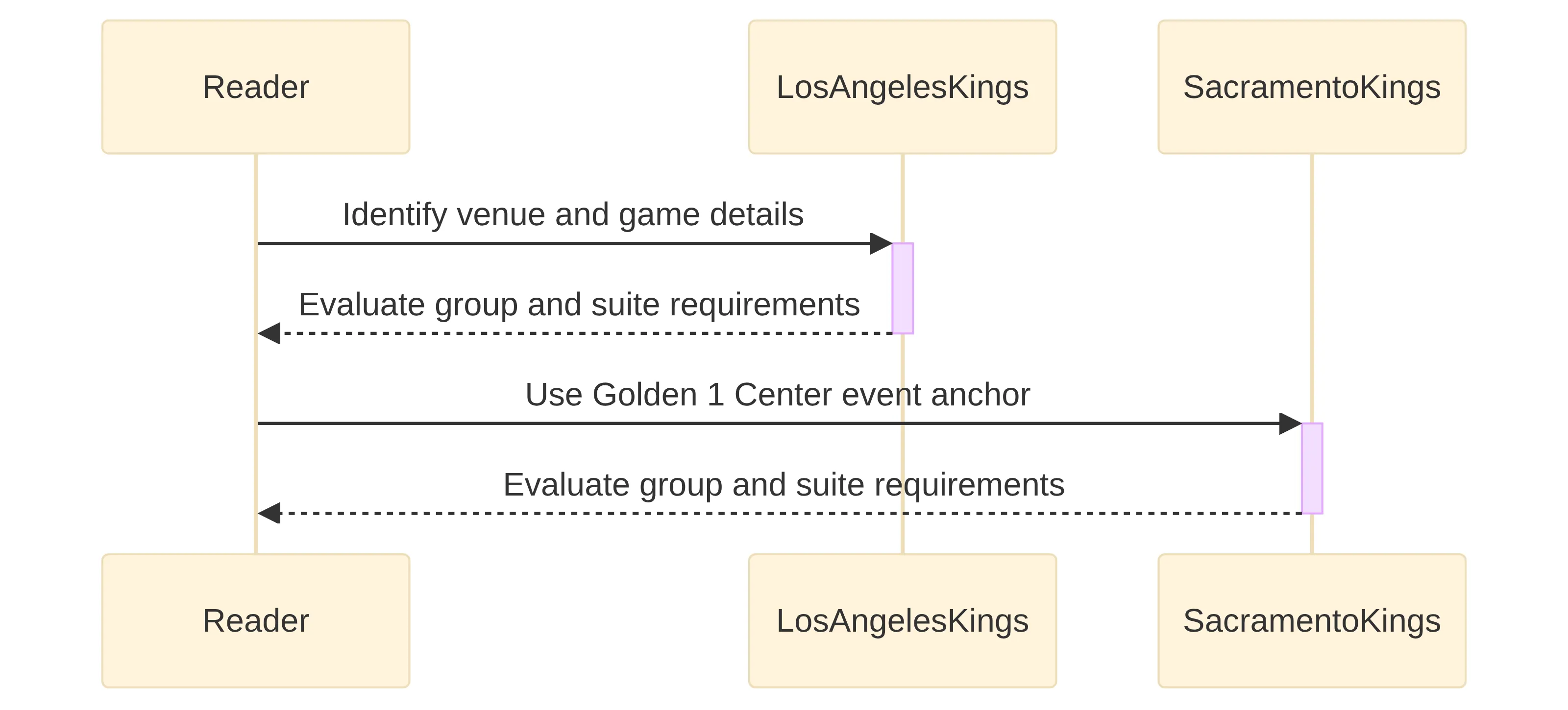
- If you mean the Los Angeles Kings, identify the venue and event details shown for the particular game, then evaluate the group and suite requirements.
- If you mean the Sacramento Kings, use the Golden 1 Center event as the planning anchor, then evaluate the group and suite requirements.
Do not combine the two paths into one budget or one amenity checklist until the team, venue, and event are fixed.
Decide whether private hospitality fits the group
A private suite is a private seating section designed to provide strong event views. We use luxury suite, luxury box, corporate box, and executive box as related terms for that type of venue seating. The format can fit a group that needs a shared private setting, but the label alone does not decide whether it suits your event.
Your group’s purpose should determine whether you continue with a suite inquiry. Test the format against four planning questions:
- What are you trying to accomplish? Client hosting may call for a private setting and a clear hospitality plan. An employee outing may place more weight on group interaction and easy coordination. A personal game experience may prioritize the view, privacy, and the event atmosphere.
- How many people are you planning for? Use the expected headcount as an initial screen, including guests, hosts, clients, and possible late additions. Do not assume a suite’s usable capacity from its name or from another event.
- What must happen during the game? Decide whether guests need room for conversation, food and beverage service, presentations, client introductions, or a simple shared viewing experience. Each requirement affects the questions you need answered.
- What budget boundary applies? Set a total ceiling or a per-guest planning limit before you receive a figure. A defined boundary lets you compare the response with the purpose of the event rather than reacting to a number in isolation.
A private suite is a reasonable format to investigate when the group benefits from shared private space and the event objective justifies the added planning. If your main requirement is the lowest-cost way to attend, compare the suite response against that requirement before proceeding.
Your decision should end in a clear fit statement: private hospitality fits because of the group’s purpose, expected attendance, and required experience, or it does not fit because another seating format would better match the budget or event objective. Keep that statement in the inquiry brief so the response addresses the real decision.
Define what the suite experience must include
The suite experience begins with private venue seating and an event view, but your usable definition should include every condition that affects the group’s experience. A private label does not establish the ticket count, food, beverage, parking, access route, or other terms for a particular game.
Your requirements checklist should separate must-haves from preferences:
- Location and view: Ask where the suite is located and what view the group should expect from that position.
- Tickets: Ask how many event tickets are included and whether the ticket arrangement matches the planned party size.
- Capacity: Ask for the usable guest capacity of the specific suite and any limits that apply to the event.
- Food and beverage: Ask whether catering, food, beverages, or a set menu are included, optional, or handled separately.
- Parking: Ask whether parking passes are part of the quoted terms, how many are provided, and whether they apply to the event date.
- Access: Ask about the entrance, suite access, ticket delivery, and any arrival instructions that affect your guests.
- Amenities: Ask which premium amenities are included in the specific option rather than relying on a general suite description.
- Restrictions: Ask about guest limits, prohibited items, timing, payment conditions, changes, and cancellation terms.
These questions turn a broad hospitality preference into a package specification. Mark each item as required, preferred, or open to alternatives.
Before comparing options, add a verification status to each line: confirmed for the exact team, game, venue, and suite under review; conditional when the response says the item depends on event or package terms; or unanswered when the response does not address it. This prevents a general listing description from being treated as a promise for the selected event. It also makes follow-up efficient: ask one question for every unanswered or conditional requirement, and keep the response tied to the same event record used for the inquiry. If the group has a non-negotiable requirement, identify it separately from preferences so an apparently attractive price does not obscure a missing operational term.
A Sacramento Kings suite listing says its Golden 1 Center premium rental price includes tickets, parking, premium amenities, and a set complimentary food-and-beverage menu. Treat that statement as a listing-specific reference, then ask whether the same inclusions apply to the exact suite and game you are considering. Do not transfer those terms to a Los Angeles Kings event or to another Sacramento option.
Compare the two Kings pricing references without combining them
The two available pricing references describe different teams and should remain separate. The ranges below are planning signals from their respective listings, not one market-wide estimate or a quote for your event.
| Team | Venue reference | Stated price reference | Stated pricing drivers | How to use it |
|---|---|---|---|---|
| Los Angeles Kings | Venue shown for the specific game | Typically $2,500–$6,000 per game | Opponent, day of the week, time of season, suite size, and suite location; the listing says prices may fluctuate during the season | Use as an indicative Los Angeles reference while requesting event-specific terms |
| Sacramento Kings | Golden 1 Center | $1,000–$22,000 for premium rentals | Specific rental space, tickets, location, and opponent | Use as a Sacramento reference tied to the particular Golden 1 Center event |
The Los Angeles range and the Sacramento range measure different listings for different teams. They cannot be averaged, added together, or used to infer a price for the other team.
Your comparison should focus on the conditions behind each figure, not on which range appears lower. A wide range may reflect different spaces, ticket arrangements, locations, opponents, or event timing. Ask which condition applies to your game before you use any number in a budget discussion.
Use price ranges as planning signals, not firm quotes
The Los Angeles and Sacramento listings show why a published range cannot replace an event-specific response. The Los Angeles listing connects price with opponent, day, season timing, suite size, and location. The Sacramento listing connects price with rental space, tickets, location, and opponent. Those conditions make the exact game and suite central to the budget.
Your planning budget should contain more than a headline range. Build a simple cost question set:
- What is the total quoted amount for the exact game and suite?
- Which tickets, if any, are included in that amount?
- Which food, beverage, parking, and premium amenities are included?
- Are taxes, service charges, delivery charges, or other fees separate?
- What payment schedule applies?
- What changes, cancellation, or rescheduling conditions affect the commitment?
- What is the resulting cost per expected guest?
Use the per-guest figure as a comparison tool, not as proof of value. A corporate host can then weigh the total against the event objective, guest list, hospitality requirements, and budget ceiling.
Your budget conversation should also account for timing. A game with a different opponent, day, or point in the season may not follow the same pricing conditions as another game. If the first option exceeds the budget, change one decision variable at a time—game, date, suite size, location, or inclusions—so you can see what changes the fit.
Do not describe an inquiry as a firm price. The inquiry is the step used to obtain event-specific information, not a guarantee of inventory, a confirmed booking, or a final financial commitment.
Build the inquiry brief before contacting LuxuryVIPSuites.com
Your inquiry brief should give LuxuryVIPSuites.com enough context to address the actual event rather than a general search for a suite. A complete brief also helps you compare the response with your original requirements.
Prepare these details before you make contact:
- Team and event: Name the Los Angeles Kings or Sacramento Kings, identify the opponent if known, and provide the event date.
- Venue: Provide the venue associated with the particular game. Use Golden 1 Center for a Sacramento event when that is the applicable venue; identify the event-specific venue for a Los Angeles game.
- Party size: Give the expected number of guests, the number of hosts, and a reasonable range if attendance is not final.
- Occasion: State whether the event is for client entertainment, employee hospitality, networking, a celebration, or a personal outing.
- Experience requirements: List required privacy, view, ticket quantity, food and beverage expectations, parking needs, access requirements, and any other material condition.
- Budget direction: Provide a total ceiling, per-guest target, or request for options within a defined range. If you cannot provide a figure, identify which cost conditions must be clear before you decide.
- Timing and contact details: Include your preferred response timing and the contact information needed to discuss the event.
Separate requirements from preferences. For example, the game date and party size may be fixed, while suite location or menu options may be flexible. That distinction gives the inquiry a practical decision structure.
A quote request is not a confirmed booking, inventory promise, or firm price. Treat it as a request for event-specific information that you can evaluate against the team, venue, game, group, and hospitality brief.
To make the request easy to evaluate, put fixed facts first and questions second. State the team, opponent, date, venue, expected party size, occasion, and budget boundary in one opening block. Follow with required items and preferences, then ask the recipient to identify what is included, what is separate, and what remains subject to confirmation. If attendance is uncertain, provide the expected range instead of implying a final count. This structure gives the response a clear comparison target without turning an inquiry into an assumption about inventory or terms.
Verify the response against the event brief
Your event brief is the standard for evaluating the response. A useful response should make it possible to distinguish the exact team and game, the proposed suite, the financial terms, and the conditions that affect the guest experience.
Check the response in this order:
- Event identity: Does it identify the correct Kings team, opponent, date, and venue?
- Suite identity: Does it identify the specific suite, location, view, or configuration being discussed?
- Group fit: Does the stated capacity and ticket arrangement match your expected party size?
- Included items: Does it identify tickets, parking, food, beverages, premium amenities, and any separate add-ons?
- Financial terms: Does it state the total amount, applicable fees, payment schedule, and conditions that affect the price?
- Operational terms: Does it explain access, ticket delivery, arrival instructions, restrictions, changes, and cancellation conditions?
- Status: Does it clearly distinguish an inquiry, a quote, a hold, or a confirmed booking?
If a required item is unclear, make that item the next question rather than filling the gap with an assumption. If the response changes the venue, date, suite, or group conditions, update the brief before comparing the price.
Then make a short decision record: retain the original requirement, copy the response beside it, and note the follow-up question or acceptance decision. For example, a ticket count can be compared with expected attendance, while a food-and-beverage statement can be marked included, optional, separate, or not specified. Use the same discipline for parking, access, amenities, and cancellation terms. If the response answers the price question but leaves a required experience or operating condition open, it is not yet a complete basis for the decision. Ask for clarification on that item rather than inferring it from a different suite, listing, or Kings team.
Your final decision should match the verified event conditions, not the general range that began the search. Proceed only when the team, game, venue, group fit, inclusions, financial terms, and booking status are clear enough for your planning responsibility.
Request a private-suite quote when the requirements are clear
A Kings private-suite decision is ready for the next step when you can name the team, game, venue, date, party size, occasion, required inclusions, and budget boundary. Keep Los Angeles Kings and Sacramento Kings pricing references separate, use ranges only for preliminary planning, and treat the event-specific response as the basis for your decision.
If the format fits the group but one requirement remains open, identify that requirement in your inquiry instead of assuming the answer. That approach gives you a direct path from event purpose to a usable suite comparison.
A qualified professional should determine whether the arrangement meets your organization’s individual requirements before you commit.
What should you confirm before pursuing a Kings private suite?
What should I consider when choosing between Los Angeles Kings and Sacramento Kings suites?
Start by identifying which team you are interested in, as their venues, games, and pricing differ. Record the specific event details, including the opponent, date, and expected party size, to avoid confusion.
How do I determine the pricing for a Kings suite?
Pricing varies based on the team, opponent, day of the week, and suite location.
What details do I need to gather before requesting a quote for a Kings suite?
Prepare information such as the team, event date, venue, expected party size, occasion, and any specific requirements for the suite experience, including amenities and budget constraints.
How can I ensure my inquiry for a Kings suite is effective?
Provide a complete brief that includes the team, event details, guest count, and specific requirements. This helps the provider address your needs accurately and efficiently.
Hosting a group?
Tell us the date and the headcount
We get back to you within one business day with what is available and what each suite costs.
Request a quote