
eagles suites
Eagles Suites: A Corporate Planner’s Guide to Choosing the Right Hospitality Format
Start with the fit decision, not the suite label
A Philadelphia Eagles private suite makes sense when your event needs a shared hospitality space, a defined guest list, and a setting that supports the purpose of the outing. The decision is less about choosing a premium label and more about matching the format to your group, budget, guest experience, and operating requirements.
Start with four questions:
- Do you need a private space for client conversations or team interaction?
- Is your expected attendance suited to a whole-suite purchase rather than individual seats?
- Does the event budget support the full package and its associated costs?
- Can you wait for the selected game’s inventory, inclusions, and venue terms to be confirmed?
If the answer to those questions is not clear, use Club Level seating as the comparison point before you ask for a suite quote.
We list private suites for Philadelphia Eagles games at Lincoln Financial Field for 16–36 guests, with the whole suite booked rather than individual seats. That makes expected attendance the first practical screen: a small group may not need the space of a larger suite, while a larger corporate outing should not be evaluated against an individual-seat format alone.
The 16–36 guest range is a listing description, not a promise that every size or configuration will be available for your game. Treat it as a starting point for your event brief, then have the selected suite, capacity, price, and inclusions confirmed for the date you are considering.
Overview
An Eagles private suite and Club Level seating solve different hospitality problems. A private suite gives you a whole enclosed event space, while Club Level gives you premium individual seating with access to shared club areas and concessions.
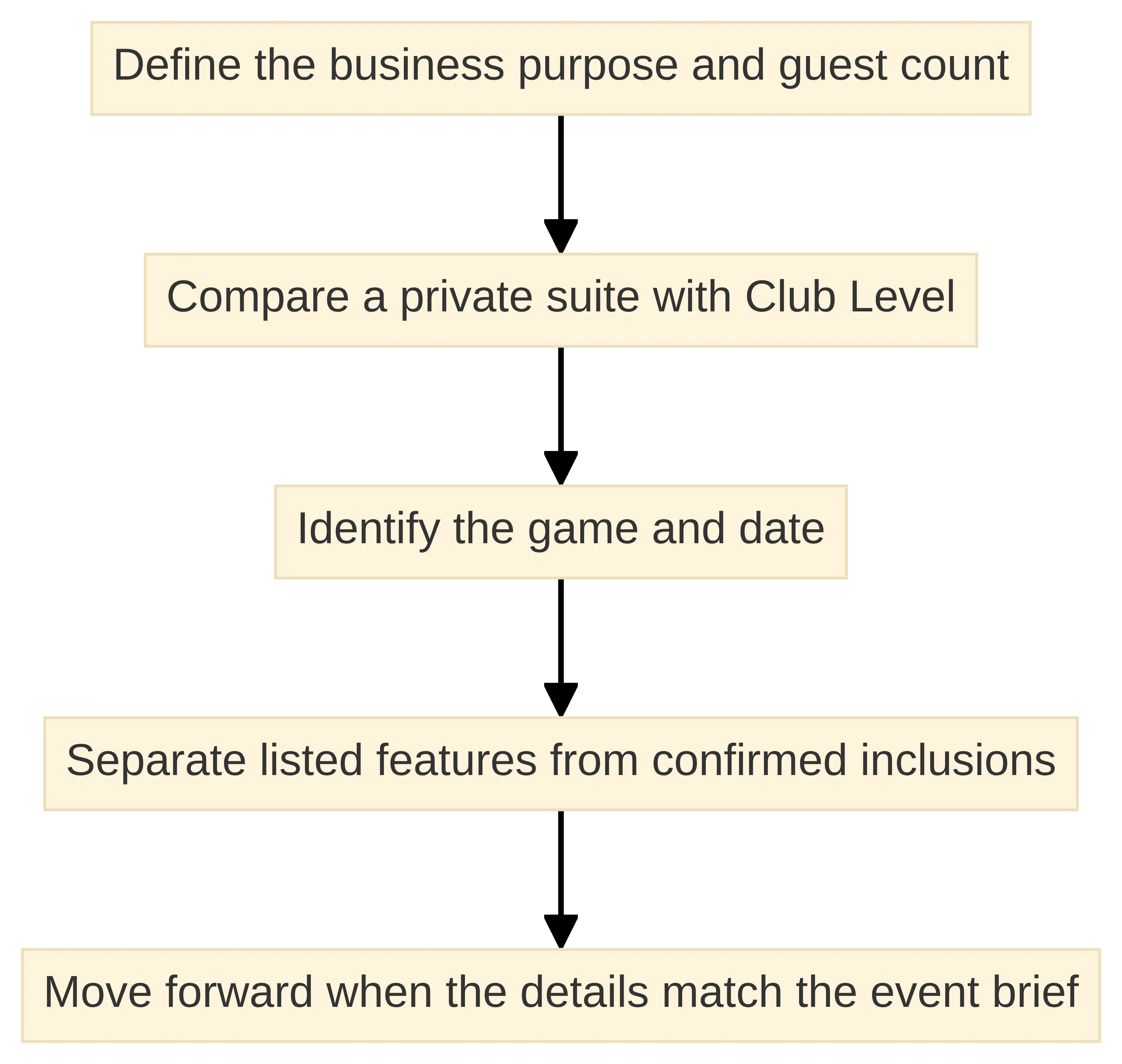
The venue and suite listing provide useful planning anchors, but neither should be treated as a date-specific quote. The practical sequence is:
- Define the business purpose and guest count.
- Compare a private suite with Club Level against the same criteria.
- Identify the game and date you want to pursue.
- Separate listed features from the inclusions that must be confirmed.
- Move forward only when the commercial and venue details match the event brief.
Read that sequence as three separate tests. The fit test asks whether privacy, shared space, guest count, and business purpose point toward a private suite or toward individual premium seats. The quote test asks whether the selected game has a specific option whose capacity, price, inventory, inclusions, and policies are stated. The approval test asks whether that option fits the organization’s budget, accessibility requirements, arrival plan, and timing. A positive answer to the fit test does not answer the quote or approval tests. Keeping those tests separate prevents a general description of suite hospitality from being treated as a date-specific offer.
This separation also clarifies what a planner is evaluating at each stage. Format information can explain the difference between a private suite and Club Level seating. A quote must identify the selected game and date and state the commercial and venue terms that apply to it. An approval decision must connect those terms to the event brief, including the guest range, business purpose, budget, and operating requirements. The result is a documented progression from suitability to quote readiness to organizational approval, rather than a conclusion based on a suite label alone.
The venue’s listed suite information describes lounge and theater-style seating and access to club lounges among the features of its suite offering. The venue’s A–Z information separately describes Club Seat access to the Club Lounges before and after events under stated time windows.
That distinction matters for planning. A suite decision concerns the space and package assigned to your group. A Club Level decision concerns where each guest sits and which shared areas and separately purchased concessions are available under the applicable event terms.
What an Eagles private suite changes for a corporate outing
A private suite changes the structure of the outing because your group books the space as a unit rather than assembling individual seats. That gives you a single hospitality setting for arrival, conversation, viewing, and departures. You can organize the guest list around the business purpose instead of treating the event as a collection of unrelated tickets.
For client entertainment, the format can support introductions and conversation before and during the game without requiring every discussion to happen in a public seating row. For a team event, the shared space can give colleagues a common base while allowing people to move between the suite environment and the game view. Those are planning advantages, not guarantees of a particular guest response.
The same venue information lists a suite access window beginning at least two hours before the game and extending up to one hour after the game concludes.
Use those features to build an operating plan rather than to assume that every suite or event carries the same inclusions. Ask which features apply to the specific suite, whether the access window applies to the selected game, and whether any food, beverage, parking, or service arrangements are separate.
A suite also adds coordination work. You need a guest list, an arrival plan, a person responsible for event-day communication, and a clear approach to hospitality spending. If clients are attending, decide who will host each relationship and how much time the event should leave for conversation. If employees are attending, decide whether the objective is recognition, team connection, relationship building, or a combination of those goals.
The private format is most useful when you will actively use the shared space. If guests mainly want individual seats and a simple game-day experience, Club Level may be easier to evaluate and administer.
Key Highlights
Use this short screen before you compare prices or ask for availability:
- Group format: A private suite is booked as a whole suite, and the listed range for Philadelphia Eagles suites is 16–36 guests.
- Package scope: The venue’s listed package includes 20 suite tickets and four valet parking passes; confirm whether those inclusions apply to your selected event.
- Operating window: The venue lists suite access beginning at least two hours before the game and continuing up to one hour afterward; confirm the event-specific terms.
- Decision boundary: Listed features are planning inputs. They are not confirmation of inventory, final price, exact capacity, or the package attached to a particular game.
The screen is designed to expose a mismatch early. If your guest count is outside the listed range, if your budget depends on a particular inclusion, or if your event requires a specific accessibility or arrival arrangement, put that condition into the brief before you compare formats. A quote that does not answer those points is not ready for approval.
Compare private space with Club Level seating
The comparison below keeps the decision tied to the same criteria. It uses listed format differences where the venue or suite information provides them, and it turns the remaining criteria into questions for your event brief.
| Criterion | Private Eagles suite | Club Level seating |
|---|---|---|
| Guest format | The whole suite is booked rather than individual seats; the listed suite range is 16–36 guests. | Guests hold individual Club Level seats in a shared seating area. |
| Hospitality setting | A private setting with listed features that include private entrances and concourses, lounge and theater-style seating, a private restroom, a wet bar, televisions, and club-lounge access. | Wider seats, strong sightlines, and access to club-level concessions are generally listed benefits; traditional Club Level tickets generally do not include food, drinks, or in-seat service. |
| Cost planning | Evaluate the full suite quote against the expected guest count and the value of using a shared hospitality space. | Evaluate the number of individual tickets, separate purchases for food or drinks, and the level of shared access required. |
| Logistics | Confirm suite capacity, ticket count, parking, access window, exact features, and event terms for the selected game. | Confirm the applicable seat location, lounge access window, concessions, and event terms for the selected game. |
| Fit signal | Stronger fit when privacy, group interaction, and a common hospitality base are central to the outing. | Stronger fit when individual premium seats and shared club areas meet the event’s needs without a private room. |
Club Level seating is generally positioned between the lower and upper bowls and offers wider seats, strong sightlines, and access to club-level concessions. Traditional Club Level tickets generally do not include food, drinks, or in-seat service, so those purchases are separate. Lincoln Financial Field also lists 8,740 Club Seats and describes Club Lounge access for Club Seat Holders before and after events under stated time windows.
Those details make Club Level a practical comparator, not a fallback that should be dismissed. If your event does not need a private setting, individual premium seats may produce a simpler operating plan. If conversation, shared hosting, and a common base are central, continue evaluating the suite format.
To keep the comparison usable in an approval discussion, separate requirements into must-haves, preferences, and open questions. A must-have might be a private setting for client conversations, a guest-count range, or an accessibility condition. A preference might be lounge access or a particular arrival experience. An open question is any item that depends on the selected game. Test both formats against the same list. This prevents an attractive listed feature from outweighing a requirement the event cannot compromise on, and it gives the person requesting a quote a concise explanation of why a suite is being considered and what an alternative would need to provide.
Match the hospitality format to the event objective
For client entertainment, start with the interaction plan. Identify the relationships you want to host, the number of people assigned to each relationship, and the amount of conversation you expect before and during the game. A private suite can fit that objective when the group needs a common space and the hosting plan depends on more than watching from individual seats.
Choose the private-suite path when the guest list and conversation plan justify booking a whole space. If each guest mainly needs a premium seat and your hosts can manage conversations in shared areas, compare the individual-seat format instead.
For a team event, start with participation and flow. Decide whether the group will arrive together, whether people need a shared base throughout the game, and whether the event is primarily recognition, connection, or entertainment. A private suite may fit when the shared environment is part of the program and the group can use the available space.
Choose the suite path when the group size, purpose, and budget support a whole-suite purchase. If the team is better served by separate premium seats and common club access, keep Club Level in the comparison.
For a budget-sensitive outing, compare total use rather than a headline figure. A suite can be a poor fit if your attendance is uncertain or if the event would leave much of the purchased capacity unused. Club Level can be easier to scope when you know the number of individual guests and the concessions or shared areas they will use.
Choose the format that matches the number of people you expect to attend and the hospitality elements you will actually use. Do not approve either option until the selected game’s price, inventory, inclusions, and venue policies are confirmed.
Prepare the event brief before requesting a quote
A useful event brief gives the quoting process a clear target. It also helps you distinguish a format that fits in principle from a specific option that fits the event you are authorized to plan.
Include these details:
- Game and date: Name the opponent or event, the preferred date, and any acceptable alternatives.
- Guest count: Give the expected attendance, a reasonable range, and the maximum number you need to host.
- Business purpose: State whether the outing is for client entertainment, employee recognition, team building, relationship development, or another defined purpose.
- Budget: Provide the approved range, whether it includes all event-related costs, and any per-guest limit your organization uses.
- Hospitality requirements: Note whether you need a private environment, food or beverage arrangements, space for conversation, or access to shared club areas.
- Arrival and parking needs: Identify valet requirements, arrival timing, transportation constraints, and the person coordinating on site.
- Accessibility needs: State any mobility, seating, route, service-animal, or other accommodation questions early.
- Approval timing: Explain when you need a decision-ready option and who must approve it.
The guest count belongs near the top of the brief because the listed suites for Philadelphia Eagles games accommodate 16–36 guests and are booked as whole suites. The venue’s listed package also identifies 20 suite tickets and four valet parking passes, while its listed access window starts at least two hours before the game and may extend up to one hour afterward.
Those figures should guide your questions, not replace confirmation. A brief that says "about 20 guests" is less useful than one that says "18 expected, 20 maximum, with four parking passes required and an arrival plan beginning before the game." Give the commercial contact enough detail to distinguish your actual requirement from a generic inquiry.
Convert the brief into a quote-request record rather than a narrative alone. Put confirmed internal inputs—preferred game, attendance range, purpose, and budget ceiling—in one block. Put questions requiring external confirmation—capacity, ticket allocation, parking, access window, amenities, separate charges, and accessibility arrangements—in another. Put fallback conditions, such as an alternate date, a different group size, or a Club Level comparison, in a third. This structure lets reviewers see what is known, what is being requested, and what would change the decision. It also reduces the risk that an unconfirmed venue detail is copied into an invitation or approval note as if it were settled.
Do not treat budget as a single number detached from the guest experience. Record what the budget must cover and what would require separate approval. For example, your internal brief can distinguish the suite or seat cost from hospitality purchases, transportation, parking, and contingency funds without assuming that any of those items are included.
Use the same budget logic for Club Level. Traditional Club Level tickets generally do not include food, drinks, or in-seat service, so separate purchases may affect the comparison. State the spending boundary plainly and ask for the selected option to be evaluated against it.
Separate listed features from confirmed inclusions
The suite listing describes private suites for Philadelphia Eagles games for 16–36 guests, while the venue’s listed package identifies 20 suite tickets. Those figures answer different planning questions and should not be collapsed into a single capacity promise. The first describes the listed suite range; the second describes a listed package detail.
Ask for the exact suite capacity, ticket count, parking allocation, access hours, amenities, and any separate hospitality charges attached to the game and date you selected. If the answer changes your guest plan or budget, update the event brief before approval.
Use this confirmation checklist for every suite option:
- What is the exact game and date?
- What is the whole-suite capacity and ticket allocation?
- Which parking passes, if any, are included?
- What access window applies on that event date?
- Which listed amenities are available in the selected suite?
- Are food, beverages, catering, or other services included or separate?
- What accessibility arrangements and routes apply?
- Which policies could affect arrival, entry, or use of the space?
Do not fill a gap with an assumption from another game, suite, or venue page.
Resolve accessibility and event-day logistics early
Arrival planning should begin with the suite access window, parking allocation, and route into the venue. The venue’s listed suite package includes four valet parking passes, and its suite information describes private entrances and concourses. Confirm that those details apply to the suite and event you are considering before you build the arrival plan.
Set a meeting point, assign an on-site contact, and tell guests when they should arrive. If the listed access window begins at least two hours before the game, decide whether your program uses that time for check-in, hospitality, client introductions, or team activities. Do not promise an arrival experience until the event-specific terms are confirmed.
Accessibility questions belong in the first event brief, not after the guest list is final. If a guest is bringing a service animal, Lincoln Financial Field advises contacting the ticket office as soon as possible because relocation to the closest accessible seating area may be necessary in some circumstances.
Contact the venue through the applicable ticket or guest-services channel early enough to ask about the route, seating arrangement, entry process, and any relocation conditions. Include the response in your event plan, and keep the guest’s privacy in mind when sharing accommodation details with colleagues.
Also assign responsibility for the details that are easy to overlook:
- Who receives the final ticket and entry information?
- Who communicates the arrival time to guests?
- Who handles a late arrival or a change in guest count?
- Who confirms parking and transportation instructions?
- Who is available to answer questions during the event?
These assignments do not establish venue policy or guarantee a particular outcome. They make your internal plan ready to absorb the confirmed terms once you have them.
Use those terms as inputs to a simple run-of-show, not as a schedule by themselves. For each milestone—guest communications, arrival, entry, hospitality setup, game start, and departure—record an owner, an expected time, and any dependency. Mark a line as pending when it relies on an unconfirmed access window, parking arrangement, or entry instruction. This gives the team a controlled way to revise the schedule if the final event terms differ from the listed description. Keep the guest-facing version shorter than the internal checklist, and do not circulate unresolved details as firm instructions.
Account for game timing without assuming availability
Game timing affects how early you should organize the inquiry, but it does not tell you whether a suite is available. Our Eagles suite guidance identifies division games, nighttime games, and holiday games as games that may sell out earlier and says that delaying can reduce available options.
Use that guidance as a planning signal, not as a statement about your selected game. It does not confirm inventory, pricing, or a booking outcome for any particular date.
Build a timing plan with three parts:
- Select your preferred game and date as soon as the business purpose and guest count are sufficiently clear.
- Identify an acceptable alternate game or date if the first option does not meet the brief.
- Send the same requirements for each option so you can compare confirmed terms rather than reacting to changing assumptions.
Do not tell guests that a suite is secured until the specific game, inventory, price, capacity, inclusions, and policies have been confirmed and your organization has approved the commitment.
Keep the inquiry record organized by game and date, and note when each response was received. If a term is revised, retain the earlier answer and identify what changed before sharing the new version internally. This is particularly useful when comparing a preferred date with an alternate because it prevents details from one option from being carried into another. The record should distinguish a confirmed answer from a request for clarification; neither the passage of time nor an early inquiry turns an unresolved item into an assurance.
Make the purchase decision only after event-specific confirmation
A private suite is ready for an internal approval decision only when the confirmed option answers the questions that shaped your brief. Compare the response with these checkpoints:
- Event: Is the game and date correct, with any backup option clearly separated?
- Capacity: Does the confirmed whole-suite capacity cover your expected and maximum attendance?
- Commercial terms: Is the price within the approved budget, and are separate hospitality costs identified?
- Inclusions: Are the ticket count, parking, access window, amenities, and club-lounge access stated for the selected event?
- Guest experience: Does the private setting support the business purpose better than Club Level seating?
- Accessibility: Are the required route, seating, service-animal, and entry questions answered?
- Operations: Do arrival timing, transportation, on-site ownership, and guest communication work for your team?
Keep the comparison disciplined. The venue’s listed suite package and Club Level descriptions provide format information, but they do not establish that a particular game has the same inventory or inclusions. Club Level generally offers wider seats, strong sightlines, and club-level concessions, while traditional Club Level tickets generally require separate purchases for food, drinks, and in-seat service. A suite listing describes a whole-suite format and listed hospitality features, but its exact event terms still need confirmation.
If the confirmed suite satisfies the guest count, business purpose, budget, accessibility requirements, and operating plan, it is ready for your organization’s approval. If it does not, compare the confirmed Club Level option or revise the event brief rather than assuming the mismatch will resolve itself.
A quote-ready decision is therefore specific, documented, and conditional. You know which game you are evaluating, how many guests you must host, what the event is meant to accomplish, what the budget includes, and which terms still control the final commitment.
That standard protects the event plan from two common errors: treating a general suite description as a reservation, and choosing a format before you know how the group will use it.
A concise approval record can make the final review easier. Identify the selected game and date, the option being considered, the guest range, the business objective, and the budget boundary. Next to each material term, mark whether it is confirmed, still awaiting clarification, or not applicable. Record the reason the private suite is preferred over Club Level—or the reason Club Level remains the better fit—and list any condition that must be resolved before commitment. This turns the quote response into a decision document rather than a collection of promotional features. It also leaves a clear handoff for the person managing guest communications, accessibility follow-up, and event-day logistics.
Request a quote when the hospitality brief is ready
Choose a Philadelphia Eagles private suite when the whole-suite format supports your guest count, business purpose, hospitality plan, and budget better than individual Club Level seating. Before you commit, carry the exact game and date, expected and maximum attendance, accessibility needs, arrival requirements, and commercial limits into the inquiry. Treat inventory, price, capacity, inclusions, access, and venue policies as event-specific conditions that must be confirmed.
For individualized financial, legal, or accessibility decisions, use the qualified professional or venue contact appropriate to that question. Once your internal brief is complete, submit the event details so the proposed format can be assessed against the requirements you have documented.
What should a planner confirm before requesting an Eagles suite quote?
What amenities are typically included in a Philadelphia Eagles suite?
A Philadelphia Eagles suite generally includes features such as private entrances, climate control, lounge and theater-style seating, a private restroom, a wet bar, multiple televisions, and access to club lounges. Specific inclusions may vary by event, so it’s important to confirm details for your selected game.
How many guests can a private suite accommodate at Lincoln Financial Field?
Private suites for Philadelphia Eagles games at Lincoln Financial Field can accommodate between 16 to 36 guests, with the entire suite booked rather than individual seats.
What is the best way to compare Eagles suites with Club Level seating?
When comparing Eagles suites with Club Level seating, consider factors such as guest count, hospitality needs, privacy, and budget. Suites offer a private space for group interaction, while Club Level seating provides individual premium seats with access to shared areas.
What should I include in my event brief when requesting a suite quote?
Your event brief should include the game and date, expected guest count, business purpose, budget, hospitality requirements, arrival and parking needs, accessibility considerations, and approval timing.
How early should I inquire about booking a suite for an Eagles game?
It’s advisable to inquire about booking a suite as early as possible, especially for popular games like division, nighttime, or holiday games, as these may sell out quickly.
Hosting a group?
Tell us the date and the headcount
We get back to you within one business day with what is available and what each suite costs.
Request a quote