
cowboys suites
Cowboys Suites: A Decision Guide for Verifying Fit, Terms, and Quote Details
When private hospitality fits a Cowboys event
Private-suite hospitality can fit a Cowboys event when your hosting objective, guest group, and operating requirements justify a separate premium setting. The suite label alone does not answer that question. Your decision should begin with the experience you need to create, then move to the event, available format, and written terms.
A private setting may suit your plans when you need your group together in one place and the occasion benefits from a distinct hospitality environment. That might include a corporate outing, client entertainment, employee recognition, or a planned gathering of friends and family. The relevant test is not whether the event is high profile. The relevant test is whether the format supports the way you expect your group to arrive, gather, watch the game, eat, and leave.
Use this initial screen:
- Choose private hospitality as a path to investigate when a shared setting, coordinated entry, and one event-level arrangement match your priorities.
- Keep group seating in consideration when your group does not need a private room or when individual seat selection matters more than a shared hospitality space.
- Pause before requesting a specific option when you do not yet know the date, expected attendance, venue, or required inclusions.
Private-suite hospitality is not automatically suitable for every event. If the objective, group, and operating requirements point toward a private setting, continue to an event-specific inquiry. If they do not, define the group-seating requirement before treating a suite as the answer.
Define the event brief before reviewing Cowboys suite options
Your event brief should identify the event, venue, target date, expected attendance, hosting objective, and required hospitality experience before you compare a private option. Private-suite hospitality fits when those operating requirements justify a separate premium setting, so an incomplete brief makes the fit decision harder to assess.
Write down the information that will govern the request:
- Event and venue: Identify the Cowboys game you are considering and specify AT&T Stadium if that is the intended venue. Do not rely on a team name alone when you request event-specific information.
- Target date: Provide the preferred date and note whether you have flexibility. If the date is not final, describe the acceptable range or the games under consideration rather than implying that any date will work.
- Expected attendance: Give the likely headcount and a realistic range if invitations are not complete. Explain whether the group includes guests who may require a particular access arrangement.
- Hosting objective: State whether the outing is for client entertainment, employee recognition, relationship building, a celebration, or a private gathering. The objective helps you decide whether a private setting is worth pursuing.
- Hospitality requirements: List the elements that affect the experience, such as a private room, a particular seating relationship, food and beverage planning, parking, arrival timing, or dedicated service.
- Decision timing: Record when you need an answer and whether you can consider another date or format if the preferred option does not fit.
The event brief is a planning document, not a reservation. Its job is to give you a clear basis for questions and to prevent a general suite description from substituting for event-specific terms. If you cannot yet supply a date or attendance estimate, request information at a preliminary level and keep the outcome open rather than treating a general response as a firm option.
Overview
A practical Cowboys-specific decision tool is a venue-verification matrix: place each published AT&T Stadium detail beside the question it leaves open for the selected game, then compare the answer with the group’s requirements. This keeps a suite description, category, or service detail from being treated as a promise of inventory, a particular suite, included features, or price.
The AT&T Stadium A-Z guide lists Field Level, Hall of Fame Level, Silver Suite Level, Ring of Honor Suite Level, and Star Suite Level among its suite levels or categories. These names provide reference points for an inquiry; they do not establish that a level is available for a particular Cowboys game.
| Published reference | Question for the selected game | Decision relevance |
|---|---|---|
| The AT&T Stadium suite page describes one room for the whole party and says it is never sold by the seat. | Does the group need one shared room, or would individual seats meet the plan? What capacity and ticket count will apply? | Tests whether the hospitality format fits the group. |
| The stadium publishes suite levels or categories. | Which category, if any, is offered for the date, and what exact features and access terms apply? | Prevents a category name from standing in for confirmed inventory or features. |
| The written response must address the event-specific commercial terms. | What amount is quoted, what is included, and which items or conditions remain separate? | Gives the group a basis for reviewing value without assuming a permanent package. |
| Parking and entry vary by suite, while the quoted terms specify what is included. | Which parking, entry, and access-window details apply to the selected option? | Surfaces arrival and guest-management requirements. |
| AT&T Stadium provides a Suite Server for each event, but Suite Servers are assigned to multiple suites and do not provide exclusive service. | Would dedicated service be needed, and can a Dedicated Suite Attendant or Suite Bartender be requested for the event? | Aligns the service expectation with the published operating model. |
Private-suite hospitality can fit when the hosting objective, guest group, and operating requirements justify a separate premium setting. It may not fit when the plan depends on individual seat purchases or a different seating arrangement. The matrix makes those differences explicit before the group treats a suite label as a decision.
An inquiry should supply the event date, venue, party size, and hospitality requirements. The response should resolve the matrix questions for that event, including capacity, ticket count, parking, access window, exact features, and event terms. If a material row remains unanswered, keep it as an open question rather than treating the initial response as confirmation.
A submitted inquiry, a quote, and a confirmed booking are separate statuses. A private-suite inquiry requests review of a Cowboys suite or group-seating option; it does not confirm inventory or establish a firm price. Proceed only after the written terms provide enough detail for the group to decide whether the selected option fits.
What a private suite changes for the group
A private suite changes the basic purchase format because the AT&T Stadium suite page describes one room for your whole party rather than individual seats sold separately. That distinction affects how you plan attendance, hospitality, guest movement, and cost. It also means you should evaluate the entire arrangement as a group experience instead of assuming that each guest can be added or removed like an individual ticket.
Start with the group experience you want:
- Shared private setting: Decide whether keeping the group in one room is a central requirement. If it is, ask for the suite capacity, ticket count, seating configuration, and access details for the selected event.
- Individual seating priority: Decide whether guests need individually purchased seats or a specific seat relationship. If that is the controlling need, ask whether a group-seating format is available rather than assuming that a private suite will provide it.
- Hospitality coordination: Identify whether food and beverage, parking, arrival timing, or service level affects the decision. Each item needs event-specific confirmation.
The private format can support a coordinated gathering, but it does not by itself establish the exact features, service, parking, or catering included with a particular option. The page describes the room-level format; your quote must resolve the operational details. If keeping the group together matters, make that requirement explicit and ask for the terms that govern the whole party.
Key Highlights
The main decision points for a private event at AT&T Stadium are fit, scope, price, operating details, and status. You can use the following summary as a working checklist before you request or review a quote.
- Fit comes first. Private-suite hospitality can fit when your hosting objective, guest group, and operating requirements justify a separate premium setting. Do not select a suite simply because the event is significant.
- The format is group-based. The AT&T Stadium suite page describes one room for your whole party, never sold by the seat. Confirm whether that format matches your attendance plan and seating needs.
A generic estimate cannot resolve the price for your selected game.
Ask for the catering treatment rather than folding an assumed amount into your budget. - Parking and entry require confirmation. They vary by suite, and the quote should specify what is included.
- Published categories are reference points. A listed suite level helps you ask a precise question, but it is not proof that a particular suite or configuration is available.
- Service details can affect execution. Ask how suite service works for the selected event, including whether any dedicated service is available and at what charge.
- An inquiry is not a booking. Treat the request as a way to obtain event-specific information, not as confirmation of inventory or a firm price.
The practical next step is to put these points into your event brief. Then request an answer that addresses each item instead of relying on a general description.
Use AT&T Stadium suite levels as reference points
AT&T Stadium’s A-Z guide lists several suite levels or categories that you can use as reference points when you describe the type of option you want. The guide lists:
- Field Level, including Field Suites and Touchdown Suites
- Hall of Fame Level, including Hall of Fame Suites, Owners Club Suites, and Legends Club Suites
- Silver Suite Level
- Ring of Honor Suite Level
- Star Suite Level
These labels help you ask whether a proposed option belongs to a particular published category. They do not establish that every category is available for your game, that every category has the same configuration, or that a listed level includes a particular service, view, parking arrangement, or catering package. The guide is a classification reference, not an event-specific quote.
Use the categories in a focused question: identify the level or category under consideration, then ask for the exact suite, capacity, ticket count, seating arrangement, access terms, inclusions, and event conditions. If the response names a different category from the one you expected, compare the actual terms rather than treating the name alone as a quality judgment.
A category can narrow the conversation, but it cannot close the decision. Proceed only when the proposed suite and its terms match the event brief.
Turn hospitality priorities into verification questions
Your hospitality priorities should become questions about the specific suite and event. A general promise of a premium setting is not enough to plan guest arrival, food and beverage, or service. Use your event brief to identify what matters, then ask for a direct answer on each point.
Privacy and group flow
Ask whether the proposed arrangement is one private room for the whole party, how many tickets are included, and how guests enter and access the suite. The AT&T Stadium suite page describes the private format as one room for the whole party, but the page does not turn that description into the capacity or access terms for your game. Ask for those terms directly.
Capacity and seating
Ask for the suite capacity, the ticket count, and the seating configuration. Confirm whether the quoted ticket count covers your expected attendance and whether any guests would be accommodated outside the private space. Do not infer capacity from a category name or from the size of another suite.
Parking and entry
Ask how many parking passes are included, where they apply, how guests receive them, and what entry route or access window governs the event. Parking and entry vary by suite, and the quoted terms should specify what is included. If arrival coordination matters, make it a written requirement in the inquiry.
Food and beverage
Ask which food-and-beverage arrangements apply to your event. Ask what menu, ordering deadline, payment process, and service arrangement apply to your event rather than relying on a general menu reference.
Service level
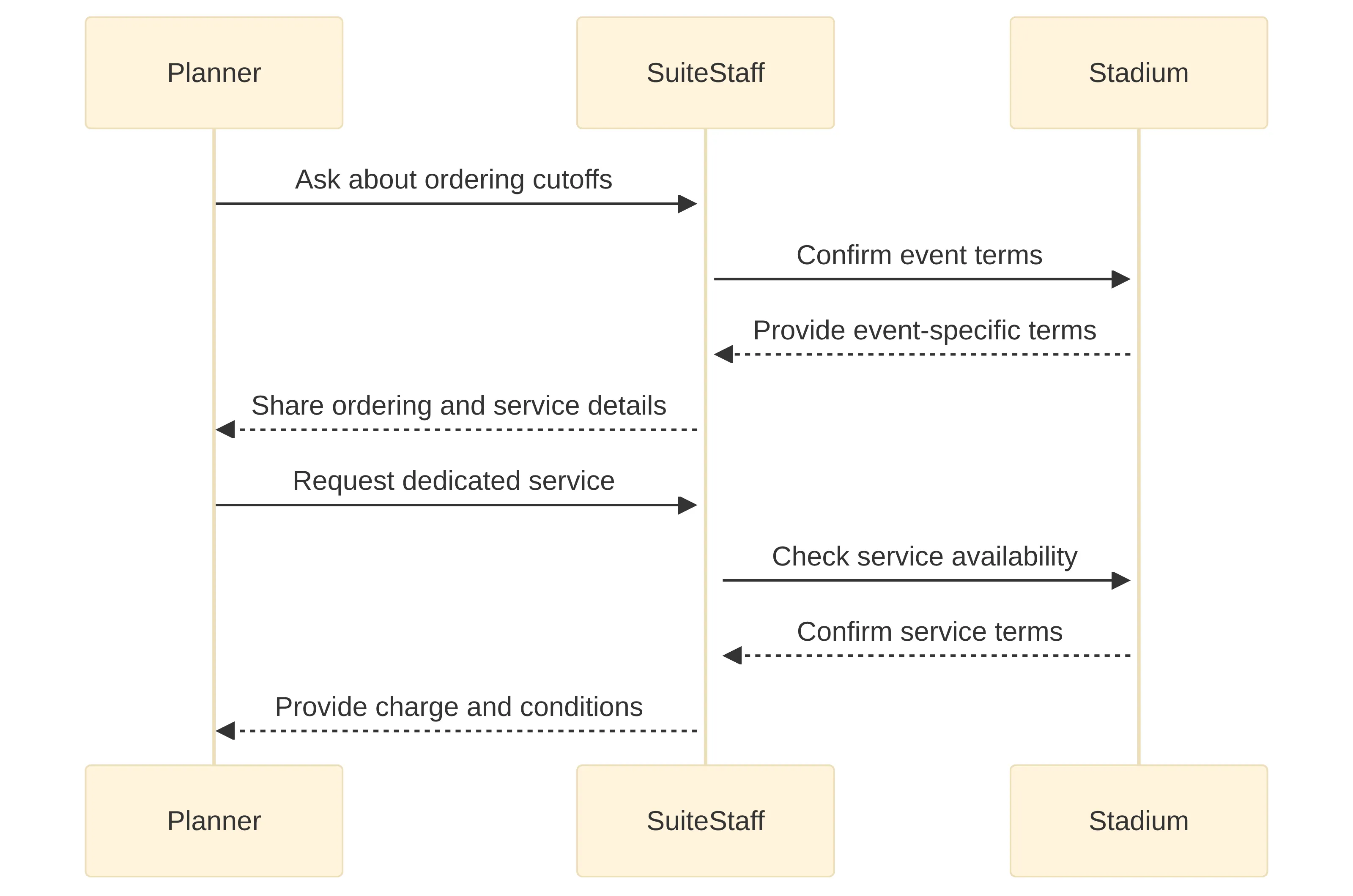
Ask whether the event includes shared suite-server coverage and whether dedicated service can be requested. The 2025–26 AT&T Stadium event-day menu stated that a Suite Server is assigned to each event, but servers are assigned to multiple suites and do not provide exclusive service. It also stated that a Dedicated Suite Attendant or Suite Bartender could be requested for $325 per event each. Because that menu applied to the 2025–26 period, ask whether the same service terms and charges apply to your event.
Finish this section of your inquiry with a short list of non-negotiables. If a requirement affects the guest experience, ask for it in the quote and do not treat a general suite description as confirmation.
Build the budget around the event-specific quote
Use the event-specific quote to document what the offer covers before comparing it with your budget.
Begin with the total amount you are prepared to consider, then separate the questions that determine what the total represents:
- What suite and event does the quote cover?
- How many tickets are included?
- Is the quoted amount for the private space and admission only, or does it include other items?
- Is catering included or priced separately?
- Are parking passes included, and if so, how many?
- Are service requests, such as a dedicated attendant or bartender, additional charges?
- Which taxes, fees, deposits, payment dates, and other conditions apply?
For parking and service, do not place an estimated value in the total unless the response identifies what you receive and under what conditions.
Per-guest planning can help you compare a full-suite quote with the value your group places on a private setting. Divide the quoted total by the expected attendance only after you know what the total includes, and show the attendance assumption beside the calculation. If your final headcount may change, calculate more than one scenario rather than presenting one per-guest figure as fixed.
A budget comparison is useful only when the inputs are comparable. Do not compare a complete suite quote with an individual-seat figure unless you have also accounted for the different format, included tickets, hospitality, parking, food and beverage, and service terms. If a quote leaves one of those items unresolved, mark it as an open cost question and request clarification before deciding.
Verify the terms that determine operational fit
Operational fit depends on the details that determine how your group will use the option on the event date. Before selecting a suite for a game, confirm the suite capacity, ticket count, parking, access window, exact features, and event terms. Those details belong in the quote review because they can change whether the option works for your group.
Use a written terms checklist with these fields:
- Event identity: Record the game, venue, event date, and any event type or schedule information used for the quote. Ask for correction if any of these details are wrong.
- Suite identity: Record the named suite, published level or category, location description, and the seating arrangement. A category alone is not a substitute for the specific option.
- Capacity and tickets: Record the stated capacity and the number of tickets included. Compare those figures with your expected attendance and identify any difference before you proceed.
- Access: Record the entry method, access window, guest instructions, and any timing condition that affects arrival. If the group will arrive in waves, ask how that affects access.
- Parking: Record the number and type of parking passes, how they are distributed, and any restriction attached to their use. The suite page says parking and entry vary by suite, so do not assume that one arrangement applies to another.
- Exact features: Record the features that matter to your objective, such as the private room, seating relationship, food and beverage arrangement, service level, or other requested inclusion. Mark every item as included, available at an additional charge, subject to request, or not included.
- Event terms: Record payment timing, deposits, taxes, fees, cancellation terms, transfer conditions, and any deadline that affects the decision. Ask for the terms that apply to the quoted option rather than assuming a general rule.
- Restrictions: Record any condition affecting guest use, ordering, access, conduct, food and beverage, or changes to the group. If a restriction would change the experience, resolve it before committing.
The checklist does not guarantee that every requested feature can be supplied. It gives you a consistent way to distinguish an included term from an assumption and an unresolved question from a confirmed condition. If the written response leaves a material item blank, keep that item open and do not treat the option as operationally suitable yet.
Check event-day service and ordering assumptions
Event-day service can affect the experience even after the suite and ticket count appear to fit. The 2025–26 AT&T Stadium event-day menu stated that food purchases could be made until the start of the fourth quarter of a football game or until 30 minutes before the scheduled end of a third-party event. It stated that beverage purchases could be made until the conclusion of the event.
Those are dated menu terms, not a permanent assumption for an event after that period. Ask which ordering deadlines apply to your selected game, who places the order, how payment is handled, and whether any event-specific instruction changes the process. If your group expects food later in the event, make that timing requirement explicit before you compare catering arrangements.
The same menu stated that AT&T Stadium provides a Suite Server for each event, while Suite Servers are assigned to multiple suites and do not provide exclusive service. For planning purposes, treat any dedicated-service request as subject to confirmation for the selected event. Treat the service description and charge as terms stated in the 2025–26 menu; ask whether they remain applicable to your event and whether the requested service has been accepted.
Use these questions to separate service assumptions from confirmed terms:
- What food-ordering cutoff applies to this event?
- What beverage-ordering cutoff applies to this event?
- Are the published cutoffs different for a football game and a third-party event?
- Is a Suite Server assigned, and what does that shared service cover?
- Is a Dedicated Suite Attendant or Suite Bartender available for this event?
- If dedicated service is requested, what charge, timing, and payment terms apply?
- Does the quoted catering arrangement include staffing, delivery, setup, or only menu items?
- What happens if the guest count or order changes?
Do not promise your guests a particular ordering window or service level until the event-specific response answers these questions. If food timing or exclusive service is material to the outing, keep that condition visible in the quote review and proceed only when the written terms address it.
Keep the inquiry, quote, and booking stages distinct
A private-suite inquiry, an event-specific quote, and a confirmed booking are separate stages. Keeping those stages distinct prevents an early conversation from being treated as proof that inventory, a particular suite, seating, inclusions, availability, or price has been secured.
Stage one: define and submit the inquiry. You provide the event date, venue, expected party size, hospitality requirements, and contact details. The purpose is to communicate what you need reviewed. A request does not by itself establish that the preferred event or suite is available.
Stage two: review the quote. You receive information about the proposed event, suite or group-seating arrangement, price, inclusions, parking, access, catering, service, restrictions, and other terms. Treat every unresolved item as an open question. If the response offers more than one path, compare each path against the same event brief rather than choosing from labels alone.
Stage three: decide whether to proceed. You compare the written terms with your required attendance, hospitality priorities, budget, timing, and operating conditions. If the quote does not answer a material question, ask for clarification before treating the option as suitable. If the option does not match the brief, keep the decision open or request a different arrangement.
Stage four: confirm only after the applicable booking conditions are satisfied. A quote is not the same as a confirmed booking, and an inquiry is not a quote. Do not tell guests that a suite is secured until the applicable confirmation and payment conditions have been completed.
This sequence also protects your internal planning. Use the inquiry to explain the requirement, the quote to evaluate the terms, and the confirmed booking to support guest communications. If the status is uncertain, describe it as under review rather than as secured.
Submit a complete private-suite inquiry
Your inquiry is ready when it gives enough information to evaluate the event without turning a preference into an assumption. Include the following in one concise request:
- The Cowboys game or event you are considering
- The venue, including AT&T Stadium when applicable
- The preferred event date and any acceptable date flexibility
- Your expected party size and likely attendance range
- The purpose of the outing and the hospitality experience you need
- Required details such as private-room format, seating, parking, access timing, catering, ordering, or service
- Questions about suite level, capacity, ticket count, inclusions, restrictions, taxes, fees, cancellation, transfer conditions, and payment timing
- Your name, organization when applicable, phone number, and email address
A complete request gives you a clearer basis for comparing the response with your event brief. It also keeps the decision focused on fit, written terms, and execution rather than on a suite label or an assumed price. The practical boundary remains the same: proceed only after the response resolves the conditions that matter to your group, and do not treat the request itself as a confirmed booking or firm price.
The decision point is straightforward: move forward only when the written response matches your attendance plan, hospitality requirements, budget, and event-day conditions. Individual suitability and contractual decisions should be assessed with the appropriate qualified professional when needed.
What should you confirm before pursuing a Cowboys suite quote?
What should I include in my inquiry for a Cowboys suite?
Your inquiry should include the Cowboys game or event, the venue (AT&T Stadium), preferred event date and flexibility, expected party size, purpose of the outing, hospitality requirements, and specific questions about suite level, capacity, ticket count, inclusions, restrictions, and payment details.
How does a private suite differ from individual seating at AT&T Stadium?
A private suite at AT&T Stadium is one room for your whole party, never sold by the seat, which allows for a coordinated group experience rather than individual ticket purchases.
What factors determine the price of a Cowboys suite?
The price of a Cowboys suite is determined by the game, the specific suite, and the day of the week, so it can vary based on these factors.
What should I verify about catering when considering a Cowboys suite?
Catering for a Cowboys suite is usually priced separately and depends on the venue, suite, and owner. You should ask whether catering is included, how it is ordered, and what menu options are available.
What details should I confirm about parking and entry for a Cowboys suite?
You should confirm the number and type of parking passes included, how they are distributed, and any restrictions on their use, as these can vary by suite.
What operational details should I check before selecting a Cowboys suite?
Before selecting a suite, confirm the suite capacity, ticket count, access window, exact features, and event terms to ensure it meets your group’s needs.
Hosting a group?
Tell us the date and the headcount
We get back to you within one business day with what is available and what each suite costs.
Request a quote